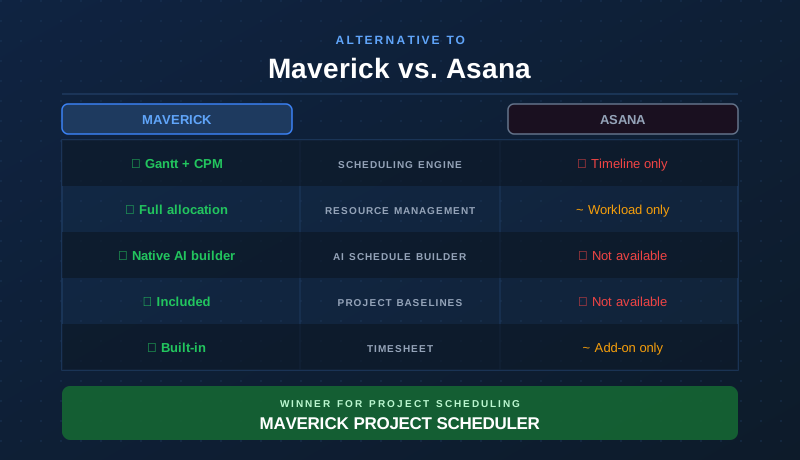
Asana is one of the most widely used task management platforms in the world — and it earns that position. It is clean, well-organized, and genuinely good at keeping teams aligned on who is doing what. For teams that run on task lists and workflow automation, Asana feels natural from day one.
But if you manage projects with real deadlines, resource constraints, and task dependencies that cascade automatically, you have probably run into Asana's ceiling. This comparison looks at both platforms honestly. Asana deserves credit where it excels. But for project managers who need a scheduling engine — Gantt charts with critical path, dependency cascading, resource allocation, and AI that actually restructures the plan — the outcome is clear.
Quick Verdict
Asana is an excellent task management and workflow tool for cross-functional teams that need to coordinate work, track status, and automate handoffs. Maverick Project Scheduler is the right tool for project managers who need a scheduling engine: Gantt charts with linked dependencies, critical path analysis, resource allocation tracking, and a built-in timesheet — all in one cloud application.
If your job is to deliver projects on time with accountability for who is doing what and when, Maverick is the better alternative to Asana for project scheduling.
Quick-Reference Comparison Table
The comparison above, summarized as a plain data table.
| Feature | Maverick | Asana |
|---|---|---|
| True Gantt chart with scheduling engine | ✓ | Timeline only |
| Critical path calculation (CPM) | ✓ | ✗ |
| Task link types (FS, FF, SS, SF) with lag | ✓ | FS only |
| Human, machine & materials resource types | ✓ | People only |
| Resource allocation bar chart | ✓ | Workload view |
| Built-in employee timesheet | ✓ | ✗ |
| AI builds and updates the project schedule | ✓ | Summaries only |
| Project baselines & variance tracking | ✓ | ✗ |
| Team collaboration & task comments | Basic | ✓ |
| Third-party integration marketplace | Core only | ✓ |
| Starting price per user / month | $8.99 (all features) | $10.99 (basic tier) |
Feature Comparison at a Glance
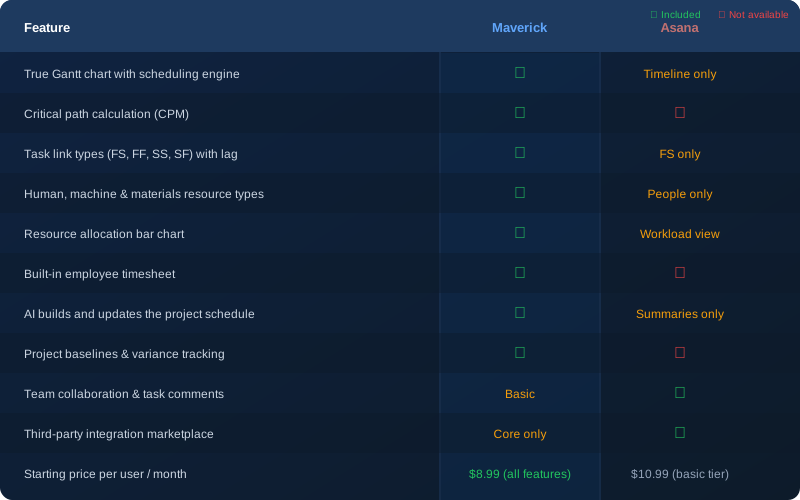
The table above reflects where each tool is purpose-built. Asana excels at task coordination, collaboration, and workflow automation. Maverick excels at scheduling discipline: dependency chains, critical path, resource loading, and variance tracking. Those are very different problems — and the right tool depends on which one you actually need to solve.
Gantt Chart and Scheduling Engine
Maverick wins clearly here. Maverick's Gantt chart is backed by a real scheduling engine. Task relationships are enforced — when a predecessor task slips, every successor shifts automatically based on its dependency type and lag. That automatic cascading is what turns a visual plan into an actual schedule.
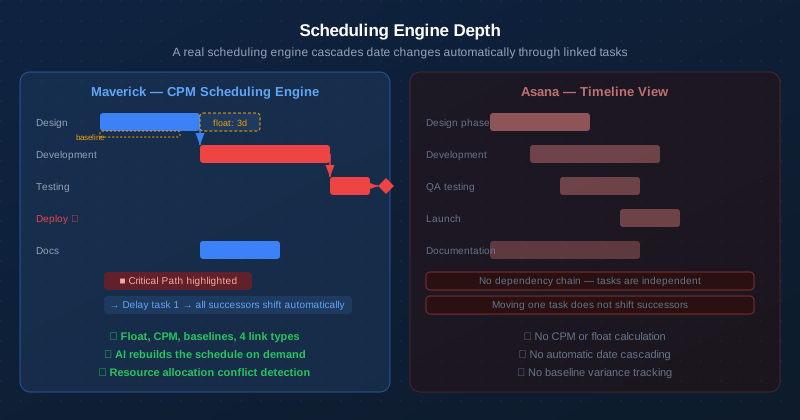
Asana offers a Timeline view on its paid plans that visually resembles a Gantt chart. You can place tasks on a timeline and draw dependency lines between them. But Asana's Timeline is not a scheduling engine — it is a visual layer. Moving a task bar does not automatically shift the tasks waiting on it. A slip on task one still requires a project manager to manually adjust every downstream date, one by one.
On a small project with five tasks, that gap is manageable. On a project with 40 or 80 linked tasks, manually cascading date changes is slow, error-prone, and exactly the kind of work a scheduling engine should eliminate. Maverick does that work automatically.
Maverick also supports four dependency link types — Finish-to-Start, Finish-to-Finish, Start-to-Start, and Start-to-Finish — with configurable lag days on every relationship. Asana supports only Finish-to-Start dependencies and does not offer lag values. For projects with overlapping phases or lead time requirements, that limitation forces manual workarounds.
Critical Path Analysis
Maverick wins. Asana does not offer this feature.
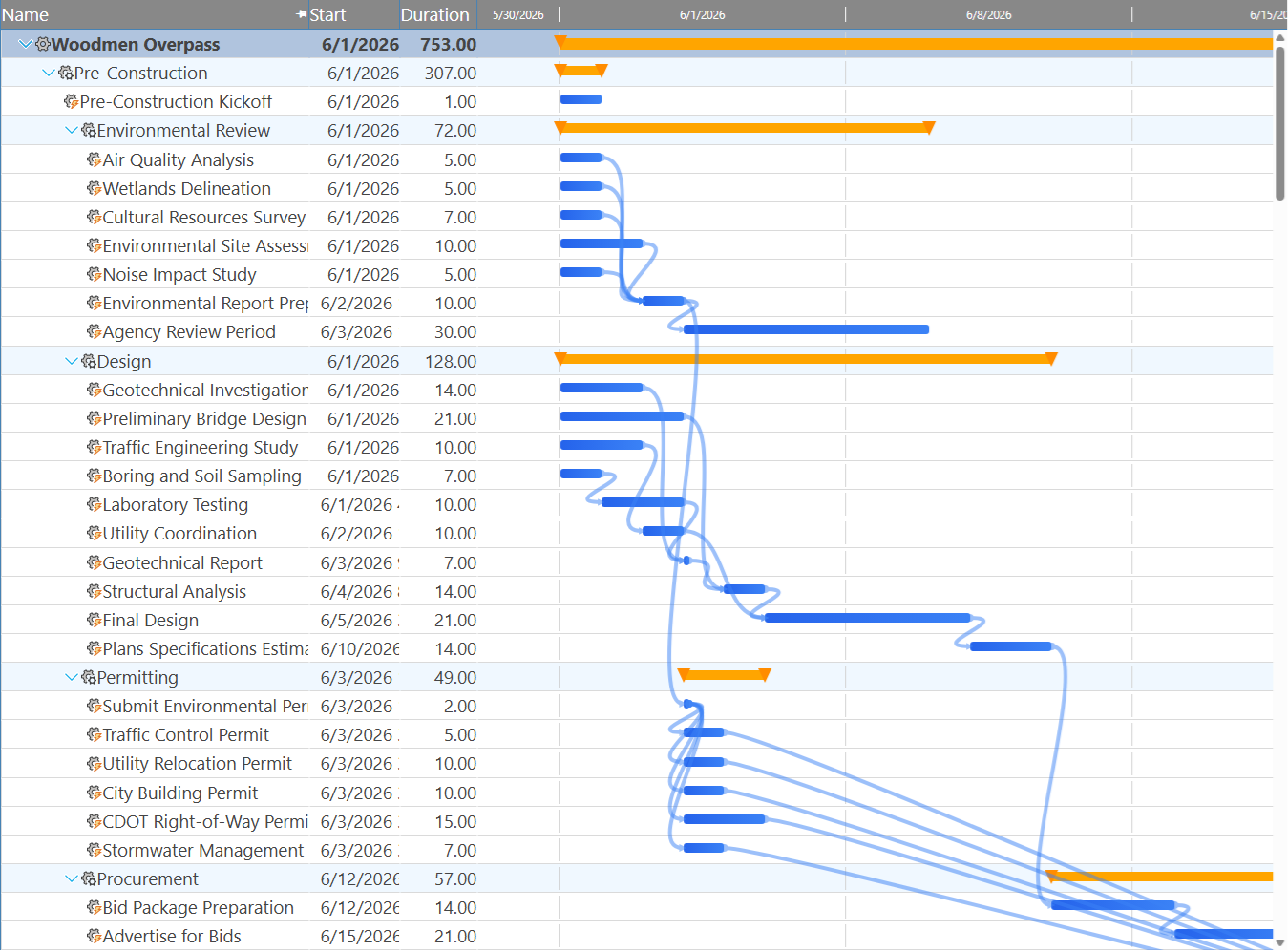
The critical path is the sequence of tasks that determines your project's earliest possible end date. Any delay to a critical task pushes the project finish date by the same amount. Maverick calculates the critical path automatically using the Critical Path Method (CPM), highlights critical tasks in red on the Gantt chart, and shows total float for every non-critical task — so you know exactly how much scheduling flexibility each task carries.
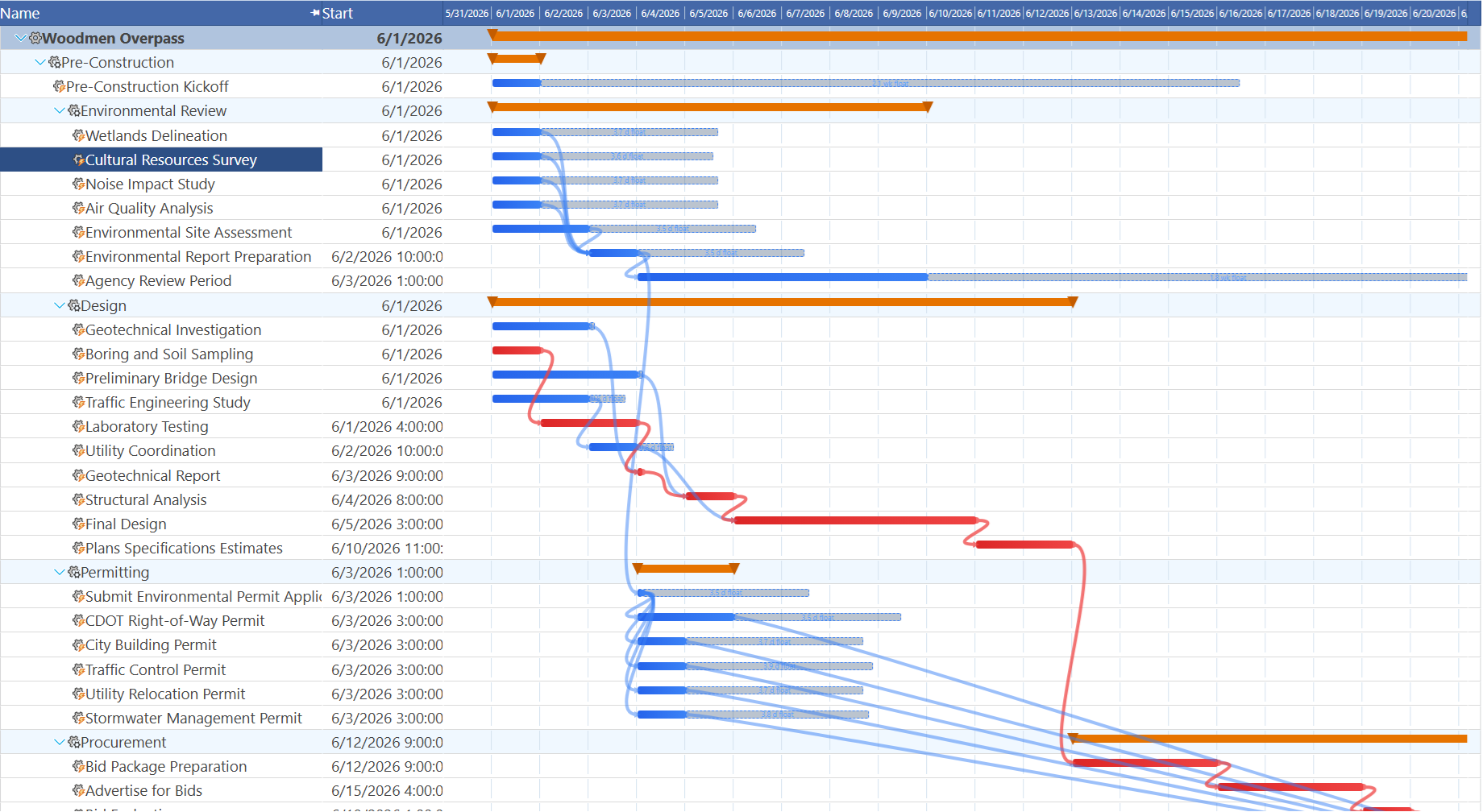
Asana has no equivalent. There is no way to identify which tasks are on the critical path, no float calculation, and no automated analysis of how a delay to any given task ripples through the schedule. For project managers who need to answer "what is at risk if this task slips by three days?" — Asana cannot provide that answer without a manual walk-through of the dependency chain.
Resource Management
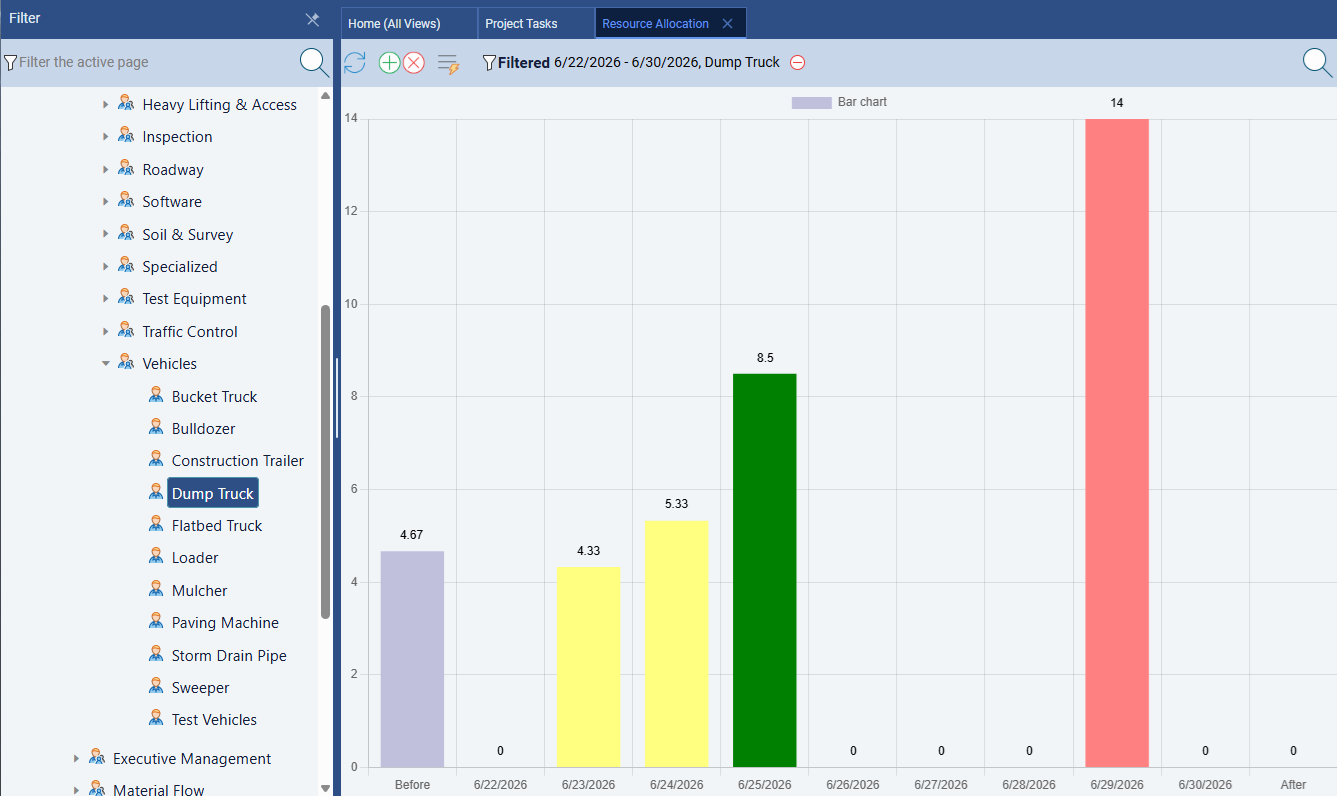
Maverick wins significantly. Maverick treats resource management as a core scheduling discipline. Human, machine, and materials resource types are tracked separately, each with their own properties, schedules, and cost rates. Task assignments carry utilization percentages or hours per day. The resource allocation bar chart displays — in color — exactly which resources are over-allocated, under-allocated, or correctly loaded across any time range you choose.
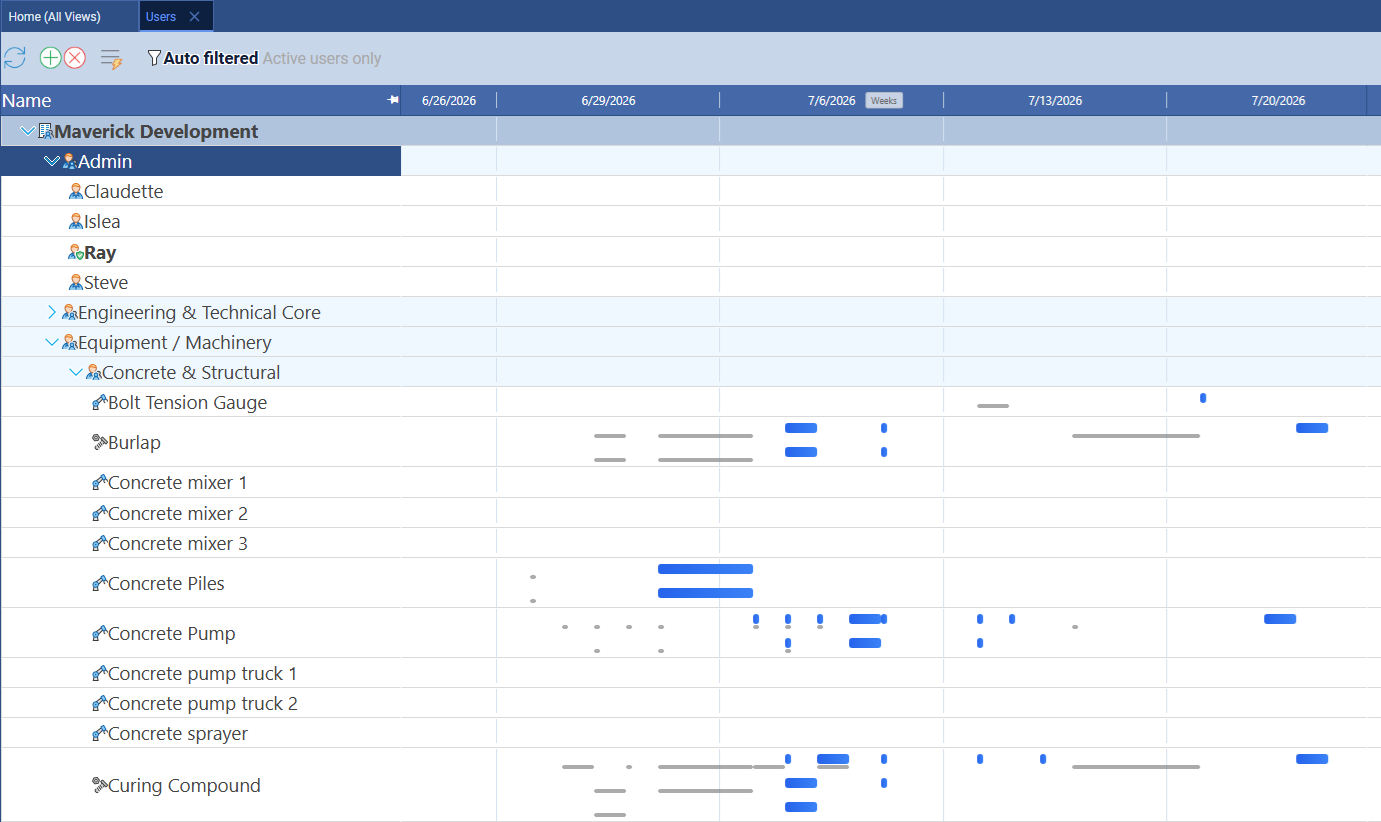
Maverick also provides a resource-centric Gantt on the Users page — a second scheduling view where rows represent resources rather than project tasks. Every task assigned to a resource appears as a bar on that resource's row, so overlapping assignments are immediately visible on the timeline. You can filter the view to a single resource type (humans, machines, or materials) to isolate where conflicts are hiding. Asana's Workload view shows task counts per person; it cannot show equipment schedules or materials loading in any form.
Asana's Workload view shows how many tasks each team member is assigned per week, which provides a rough sense of who is busy. But it does not differentiate between human and non-human resources, does not factor in individual working-hour schedules or utilization percentages, and does not produce the color-coded conflict alerts that Maverick's allocation chart provides. Knowing a person has five tasks this week is useful — knowing they are loaded at 140% of available hours is actionable.
Maverick also supports resource-specific working hour schedules, so a part-time contractor working four days a week is correctly accounted for when calculating task durations and resource loading. Asana does not model individual working schedules at this level.
AI and Automation
Maverick wins on scheduling depth. Asana wins on workflow automation breadth.
Asana has built a capable rules engine for workflow automation — triggering actions when tasks change status, when due dates arrive, or when fields meet certain conditions. Asana Intelligence also offers AI-generated summaries of project status and smart goal tracking. For teams that want automated handoffs and status digests, Asana's automation features are genuinely useful.
Maverick's AI works differently. Instead of automating notifications and status updates, Maverick's AI reads your project — its tasks, resources, dependencies, constraints, and timeline — and restructures the schedule in response to plain-English instructions. You can ask it to reschedule everything after a delay, assign the best-fit resource to each unassigned task, or build a new project plan from a description. The AI acts as a scheduling assistant, not a status router.
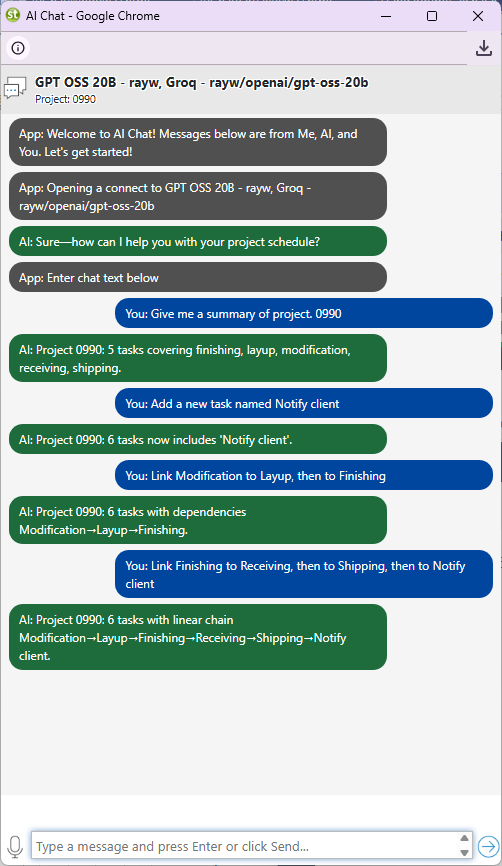
Maverick also lets you configure different AI providers and models per employee — so a power user working on a complex plan can use a premium model while the broader team uses a cost-effective one. This per-employee AI configuration has no equivalent in Asana.
Time Tracking and Timesheets
Maverick wins. Asana requires third-party integrations for equivalent functionality.
Maverick includes a full employee timesheet as a built-in feature — no add-on required and no third-party integration to configure. Team members log hours against specific tasks and projects directly in Maverick. Managers can filter timesheets by user, project, and date range to see exactly where time is going. Actual hours flow back into cost calculations automatically.
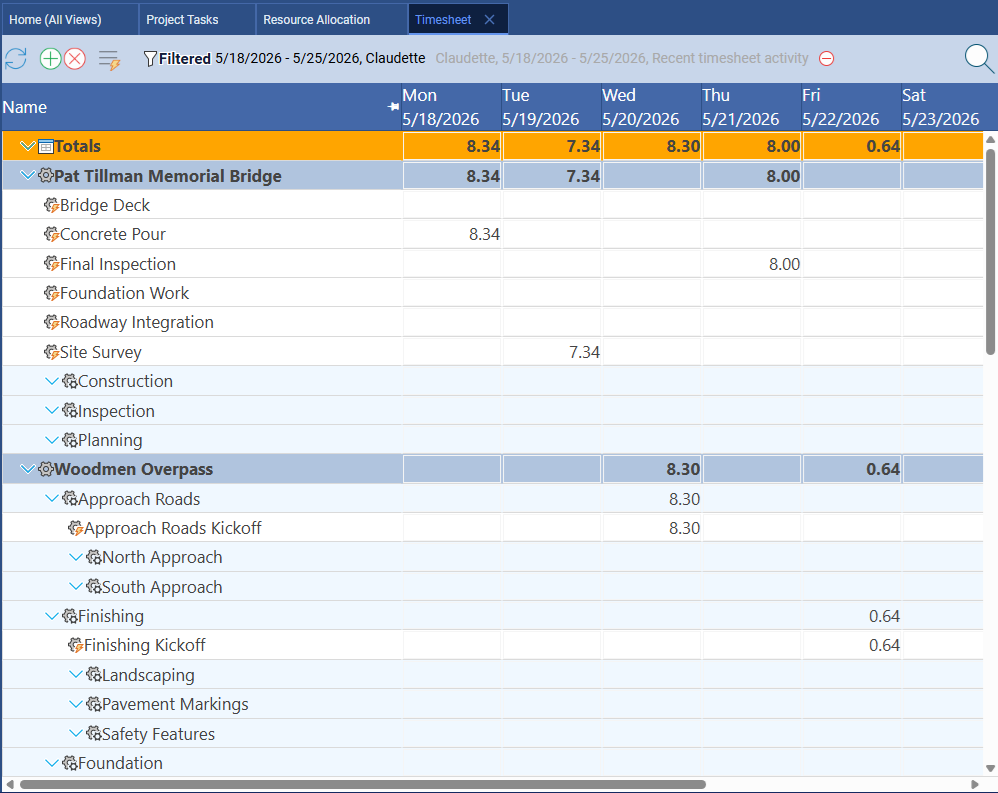
Asana does not include native time tracking. Logging hours against tasks requires connecting a third-party tool like Harvest, Toggl, or Clockify. Each integration adds setup complexity, a separate data silo, and often an additional subscription cost. For teams that want time tracking as a native part of their project workflow — not maintained separately — Maverick's built-in approach is simpler and more reliable.
Project Baselines and Variance Tracking
Maverick wins. Asana does not offer project baselines.
A project baseline is a snapshot of your original plan — dates, durations, and milestones — taken at project approval or kickoff. As the project progresses, you compare actual performance against that baseline to understand how far the schedule has drifted and why. Maverick supports baselines natively, displaying ghost bars on the Gantt chart alongside the live schedule so the original plan is always visible for comparison.
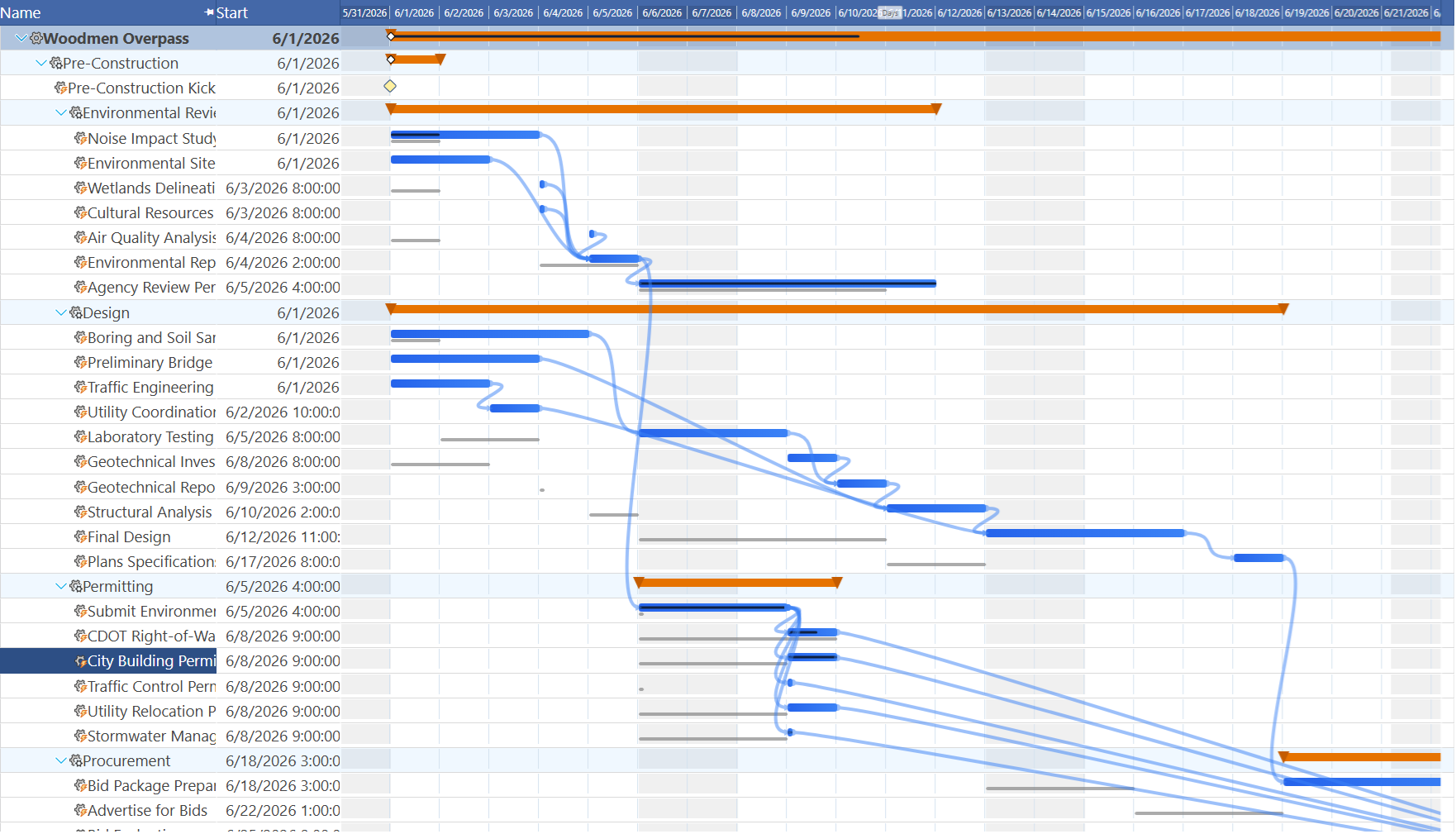
Asana has no baseline feature. Once you update a task's due date, the original planned date is replaced and gone. For project managers who present schedule variance to stakeholders — or who need a post-project audit of how the plan evolved — this is a meaningful gap that cannot be addressed within Asana without external tooling.
Team Collaboration and Task Management
Asana wins this category.
Asana's collaboration features are among the best in its class. Task comments, @mentions, attachments, subtasks, and a team inbox create a rich communication layer directly on top of the work. Custom fields, task dependencies visible to assignees, and portfolio-level dashboards give managers and team members a shared context that is genuinely easy to navigate.
Maverick's collaboration model is built around the schedule — comments and task details live in the properties panel, and the primary interface is the Gantt chart and task grid rather than a team feed. For teams whose primary need is rich social collaboration around tasks, Asana's communication features are more developed. For teams whose primary need is delivering a defined schedule, Maverick's interface is purpose-built for that job.
Integrations and Ecosystem
Asana wins this category.
Asana has built an extensive integration marketplace with connections to Slack, Microsoft Teams, Google Drive, Salesforce, Jira, GitHub, Zoom, and hundreds more third-party tools. If your organization runs a diverse SaaS stack and needs your project tool to plug into all of it natively, Asana's ecosystem is a genuine advantage.
Maverick focuses on the integrations that project managers use most: Microsoft Project import and export, Excel, CSV, and database connections for scheduled data exchange. If deep SaaS integration breadth is your top priority, Asana has the wider catalog. For most project scheduling workflows — where the primary input is a work breakdown structure and the primary output is a delivered project — Maverick's core integrations cover what matters.
Pricing
Maverick delivers more for the price.
Maverick starts at $8.99 per user per month and includes all Pro features — AI scheduling, resource allocation charts, built-in timesheets, baselines, custom reporting, and automated exports — as part of every subscription during the current promotional period. There are no gated tiers for core project scheduling capabilities.
Asana's pricing starts at a higher per-seat rate on the paid tiers needed for Timeline, advanced rules, and reporting. The features a project manager needs — Timeline access, workload view, custom rules, and advanced reporting — are gated behind the Premium or Business plan. When you total the actual cost of the capabilities required for a managed project, Maverick's all-in price is typically lower.
Final Verdict: Which Tool Should You Choose?
Asana is a well-designed task management platform that excels for cross-functional teams who need rich collaboration, workflow automation, and a broad integration ecosystem. If you coordinate marketing campaigns, manage product launches with many stakeholders, or run operations workflows where status communication is the primary need — Asana is a strong choice.
But if you are a project manager responsible for delivering projects with defined timelines, resource constraints, dependency chains, and stakeholder accountability for schedule variance, Asana leaves critical gaps. No CPM. No automatic dependency cascading. No resource allocation bar chart. No built-in timesheet. No baselines. These are not edge-case features — they are the foundation of professional project scheduling.
Maverick Project Scheduler was built specifically for this discipline. The scheduling engine, resource management, AI integration, and built-in timesheet work together as a coherent system — not a collection of bolt-on features. The result is a tool that helps you plan accurately, track honestly, and deliver on time.