Battery & Energy Storage Engineering
Project Scheduling Software for Battery Energy Storage Engineers
A BESS schedule answers to constraints a generic construction timeline doesn't have: the chemistry spec changes commissioning durations before a single module ships, a battery management system and a power conversion system can only close out together, and two certified specialists — not two crews — are usually the tightest resource in the whole project. Maverick schedules the equipment, materials, and specialists behind a BESS build as first-class resources, not a task list with names attached.
Try It FreeBESS Project Types Maverick Schedules
Every project type below runs on the same mechanics — subproject hierarchy, three resource types, dependency links, baselines — but the constraint that actually threatens the finish date changes with the site.
Utility-Scale Standalone BESS
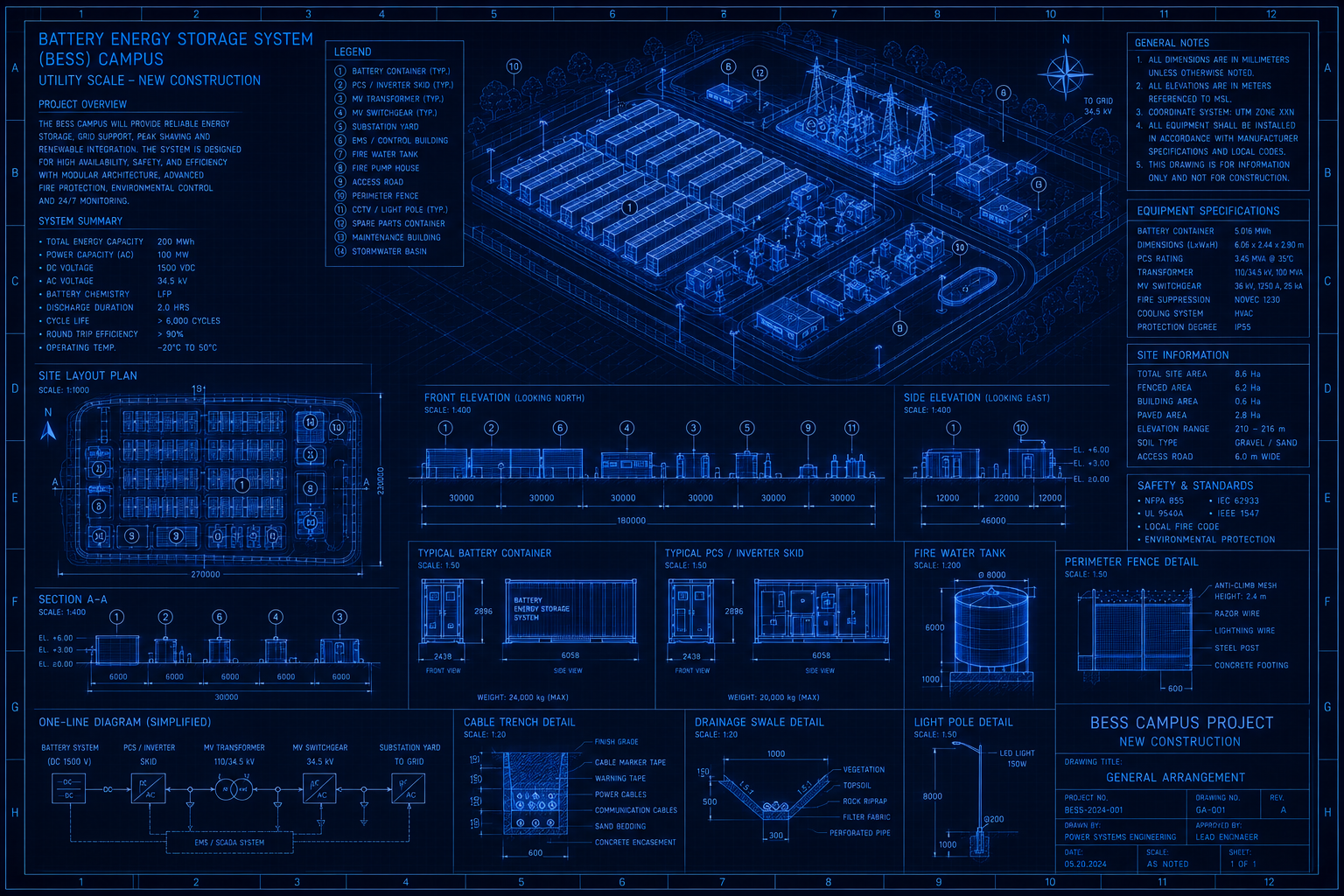
A 10+ MW facility interconnected directly to the grid, where the utility witness test and permission-to-operate sign-off — not construction — usually sets the finish date. The project type behind the blueprint below.
See the blueprintCommercial & Industrial (Behind-the-Meter)
Peak-shaving and demand-charge reduction systems sited on a customer's property, where an interconnection application to the local utility often has a longer queue than the physical install itself.
See how milestones workCommunity & Residential Storage Fleets
Many small enclosures deployed in parallel across different permitting jurisdictions, each with its own inspection calendar — crew routing and allocation across sites matters more here than any single task's duration.
See the allocation chartSolar-Plus-Storage Hybrid
The PV array and the storage system share one interconnection point and commission together, not separately — the same Finish-to-Finish pattern that ties a standalone BESS build's BMS and PCS commissioning tasks together.
See Maverick for solar engineersMicrogrid & Resiliency Storage
Storage sized for islanded operation during a grid outage adds a black-start and transfer-switch test to commissioning — a milestone with no equivalent on a grid-tied-only project, gated behind its own sign-off.
See dependency link typesAugmentation & Repowering
Adding capacity to an aging, producing site means scheduling de-energized work zones around racks that must stay online, with a safety sign-off gating each zone before crews can enter it.
Learn about critical pathWhy Battery Chemistry Changes Your Schedule
The chemistry specified for a BESS project has a direct effect on task durations in module installation and commissioning — not just the system's operating life.
A project specifying Vanadium Flow chemistry has an electrolyte-filling step and a formation-cycling phase that don't exist at all in an LFP project. NCA adds a separate fire-suppression commissioning phase most LFP builds don't need. None of this shows up on a generic task list — it has to be entered as a real duration and dependency, which means the chemistry decision belongs in the schedule as early as the resource pool, not discovered during commissioning.
| Chemistry | Round-Trip Efficiency | Cycle Life | Thermal Risk | Schedule Impact |
|---|---|---|---|---|
| LFP (Lithium Iron Phosphate) | 95–98% | 3,000–6,000 cycles | Low | Standard; dominates grid-scale BESS in the US |
| NMC (Nickel Manganese Cobalt) | 92–96% | 1,000–2,000 cycles | Moderate | Tighter thermal management tasks in commissioning |
| NCA (Nickel Cobalt Aluminum) | 90–95% | 800–1,500 cycles | Higher | Fire suppression system adds a separate commissioning phase |
| VRLA (Lead-Acid) | 75–85% | 200–400 cycles | Low | Short cycle life means replacement is a scheduled event within project life |
| Vanadium Flow | 70–80% | 20,000+ cycles | Very Low | Electrolyte filling and formation cycling add 2–3 weeks to commissioning |
| Al-ion (Aluminum-ion) | 92–96% | 10,000+ cycles | Very Low | No dendrite formation; no specialized electrolyte handling; commissioning mirrors LFP |
Built for BESS Scheduling
The same scheduling mechanics, mapped to what actually happens on a BESS build.
| Feature | What It Solves | Where It Shows Up on a BESS Project |
|---|---|---|
| Finish-to-Finish Dependency Links | Two systems commissioned by different crews that must sign off together | BMS and PCS commissioning tasks pinned together — neither closes until both confirm the integration handshake |
| Three Resource Types | Materials, machines, and people scheduled and checked for conflicts on one chart | Battery cells as material, mobile crane as machine, Battery Technician as human — all on the same task |
| Critical Path Method | Surfaces which delay actually threatens the finish date | A 12–26 week cell or transformer procurement lead time showing up as the true constraint, not the field crew |
| Resource Allocation Bar Chart | Flags a double-booked resource before the baseline is locked | Catches a Commissioning Engineer or Protection Relay Specialist assigned to overlapping tasks |
| AI Chat Project Creation | Builds phase structure, resource pool, and dependencies from written prompts | The entire BESS blueprint below was built this way — zero tasks entered manually |
| Project Baselines | Locks the plan so later variance is documented, not absorbed silently | An AI-drafted plan re-baselined after self-review corrects the structure |
Proof: A Schedule the AI Built, Not You
One worked example — the only blueprint in the series where AI chat built the entire schedule from conversational prompts.
10 MW / 20 MWh Battery Energy Storage System
Eight construction phases, three resource types identified and assigned entirely through AI chat, a Finish-to-Finish link pinning BMS and PCS commissioning together, and a critical path that runs through long-lead procurement and the utility interconnect test — built without a single task entered by hand.
Walk Through the BlueprintReport Commissioning Status Without a Maverick Login
Owners, financiers, and offtakers usually want schedule status outside the scheduling tool itself.
Power BI Dashboards
Build schedule health, Gantt timeline, and commissioning-milestone dashboards from live project data, so an asset owner or financier can check status without ever logging into Maverick.
See the Power BI dashboardsLive OData Feed
Pull projects, tasks, resources, and costs directly into Power BI, Excel, or any OData v4 client via the built-in feed — all 11 entity sets documented with ready-to-paste M queries.
See the OData schema referenceCommon Questions From BESS Engineering Teams
What battery storage EPC and asset teams ask before switching their scheduling.