Solar Engineering
Project Scheduling Software for Solar Engineers
Solar EPC schedules live or die on a handful of hard constraints: an interconnection queue and permission-to-operate date set by someone else's utility, module and inverter shipments that can run months behind a signed contract, and racking, electrical, and commissioning crews all competing for the same laydown yard. Maverick schedules the whole EPC lifecycle — not just the labor.
Try It FreeThe Solar EPC Schedule, Stage by Stage
Six stages, one schedule — from first grading cut to the utility's permission-to-operate sign-off.
Site Civil & Racking
Grading, pile driving, and racking assembly go in as the first subprojects. This work is weather-dependent and usually the first thing a rain delay pushes back — every downstream stage inherits that slip unless it is tracked from day one.
Module & Inverter Procurement
Panels, inverters, and transformers are flagged as long-lead material resources the moment the contract is signed, often before the first crew is even mobilized, so a shipment delay is visible months before it would otherwise hit the schedule.
Electrical Balance-of-Plant
DC wiring, combiner boxes, and AC collection follow racking and module installation with Start-to-Start dependencies and a lag, so electrical crews can begin stringing one section while racking crews are still finishing the next.
Interconnection & Utility Coordination
Utility witness testing and protection relay approval are gated as zero-duration milestones, not buried inside a generic "commissioning" task — this is usually the one date the whole project actually answers to.
Commissioning & Performance Testing
String testing, SCADA integration, and punch-list closeout run against a locked baseline, so the EPC contractor and owner can point to a documented plan when a performance test slips a few days.
Permission to Operate & Energization
The utility's PTO sign-off is the milestone the entire schedule has been built around — everything upstream exists to hit this date, and everything downstream (production, revenue, warranty clocks) starts counting from it.
Solar Project Types Maverick Schedules
Every solar project type below shares the same six stages above — what changes is where the real risk hides.
Utility-Scale Ground-Mount
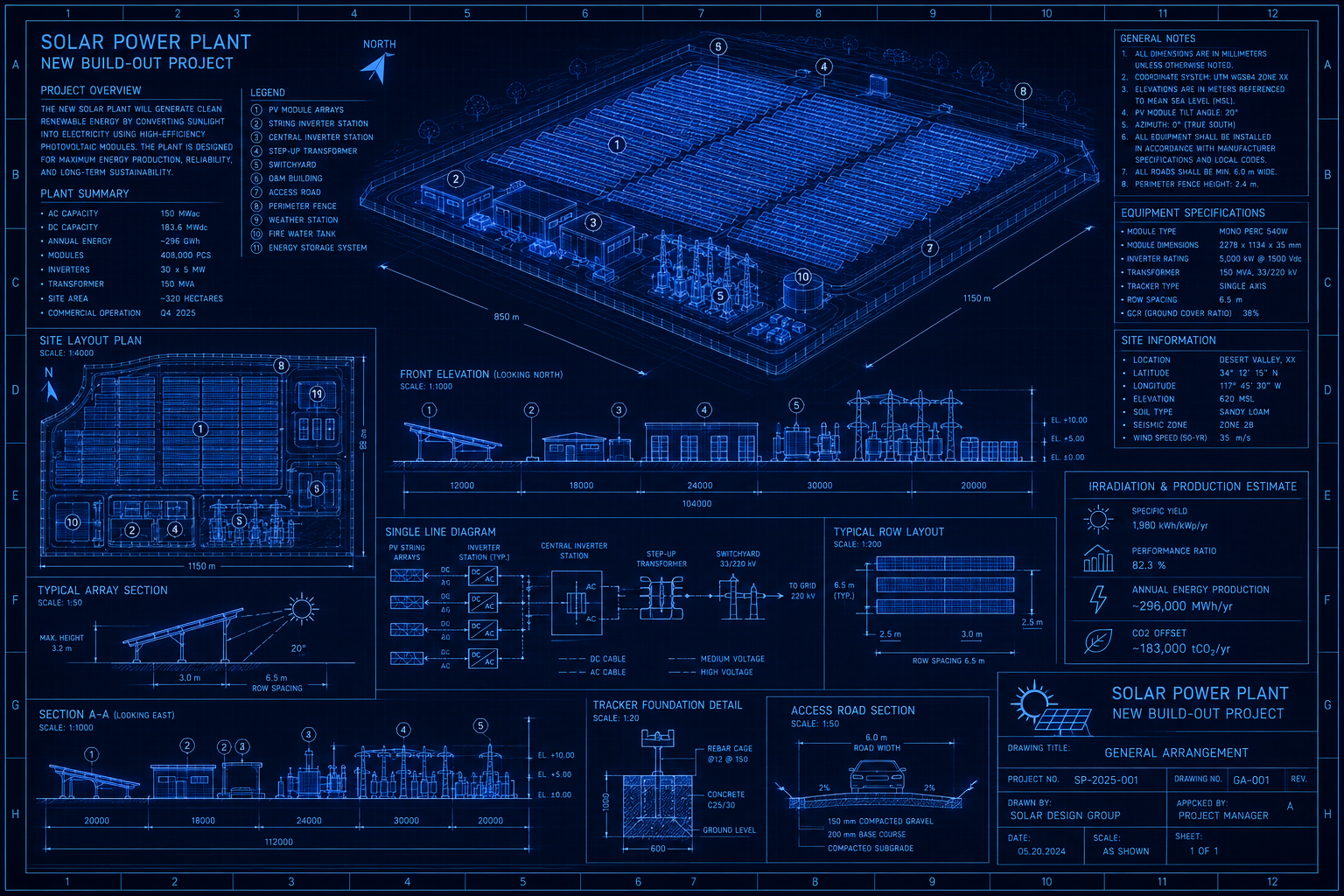
50+ acre, multi-megawatt arrays built against a fixed utility interconnection deadline. Racking and panel crews work parallel array sections while pile driving, string wiring, and AC collection all compete for the same crane and grounding crew — the project type behind the blueprint below.
See the blueprintCommercial & Industrial Rooftop / Carport
Roof penetrations and structural load work need building-owner sign-off before racking starts, and carport installs often phase around an active parking lot without closing it. Subproject hierarchy keeps each roof section or carport row scheduled independently while still rolling up to one portfolio view.
See subproject hierarchyCommunity Solar Gardens
Subscriber enrollment and state program compliance deadlines run in parallel with a smaller-scale build. Tracking enrollment and regulatory filing dates as milestones alongside construction means a missed program deadline is exactly as visible as a missed construction date.
See how milestones workSolar + Battery Storage Hybrid
A shared interconnection point means the PV array and the battery energy storage system commission together, not separately — the same Finish-to-Finish pattern used to pin a standalone BESS build's BMS and PCS commissioning tasks together.
See the BESS blueprintDistributed Residential Fleet
Dozens or hundreds of small 5–15 kW installs run in parallel across different permitting jurisdictions, each with its own inspection schedule. Crew routing and allocation across that many small sites matter more here than any single task's duration.
See the allocation chartRepowering & Module Replacement
Replacing aging modules or inverters on a live, producing array means scheduling de-energized work zones around sections that must keep generating, with a safety sign-off gating each zone before crews can enter it.
See dependency link typesAI-Built Solar Schedules
The same AI chat that drafted the Kingman Solar Plant blueprint below can draft yours.
Describe the array and its phases in plain language, and AI chat builds the subproject structure for you to review and refine:
Create a new project named 'Sagebrush Solar 5MW Ground-Mount'. Add only the top-level summary phases — do not add individual tasks yet. Use these phases: Site Civil & Grading, Racking & Pile Installation, Module Installation, DC Electrical & Combiners, AC Collection & Switchgear, Interconnection & Utility Testing, Commissioning & PTO.
Once crews and equipment are in the resource pool, chat with AI to analyze the live project instead of manually scanning the Gantt chart for conflicts:
Identify crew conflicts between the racking crew and the panel installation crew working overlapping array sections this week, and suggest how to resolve them.
Different roles can run this on different models — a scheduling engineer analyzing a 300-task array might want a large-context model, while a field lead checking tomorrow's assignments is fine with something faster. Per-employee AI provider assignment makes that a per-person choice, not a company-wide compromise.
Proof: A Real Solar Schedule
One worked example, built entirely inside Maverick.
Kingman Solar Plant — 5MW Ground-Mount Build
31 tasks across seven phases, staggered racking and panel crews working three array sections in parallel, a pile driver and crane scheduled as machine resources, and a baseline locked against a fixed utility interconnect deadline.
Walk Through the BlueprintReport Production and Schedule Data to Stakeholders
Owners, financiers, and off-takers usually want schedule status outside of a Maverick login.
Power BI Dashboards
Build schedule health, Gantt timeline, and cost dashboards from live project data so an asset owner or financier can check status without ever logging into Maverick.
See the Power BI dashboardsLive OData Feed
Pull projects, tasks, resources, and costs directly into Power BI, Excel, or any OData v4 client via the built-in feed — all 11 entity sets documented with ready-to-paste M queries.
See the OData schema referenceCommon Questions From Solar Engineering Teams
What solar EPC teams ask before switching their scheduling.