Already live in ChatGPT all day? You can plug it straight into your Maverick account and ask about your jobs, tasks, and hours without leaving the chat. It signs in as you, sees only what you are allowed to see, and shows a preview before it changes anything. This is the same MCP Server that Claude uses, so the safety rules are identical. If you use Claude instead, see Connect Claude to Maverick.
In plain terms: type something like With Maverick, how many employee hours were logged this week? and get an answer drawn from your own live data. Ask for a small project with tasks and ChatGPT shows exactly what it would create, waits for your approval, and lets you undo it afterward.
The Short Version
- It acts as you. Your login, your rights. ChatGPT never sees more than you do.
- Preview first. Every change is shown before it is saved, and you approve it.
- A 30-minute undo. Changed your mind? Undo works for 30 minutes after applying.
- Cut it off anytime. Revoke the connection in Maverick and access ends at once.
How ChatGPT Reaches Your Maverick Data
Model Context Protocol (MCP) is an open standard that lets an AI assistant connect to outside tools and data. ChatGPT calls these doorways custom MCP servers and installs each one as a plugin. You connect once; after that ChatGPT can look things up in Maverick whenever you ask, using the same rights checks and safety rules that apply to Claude.
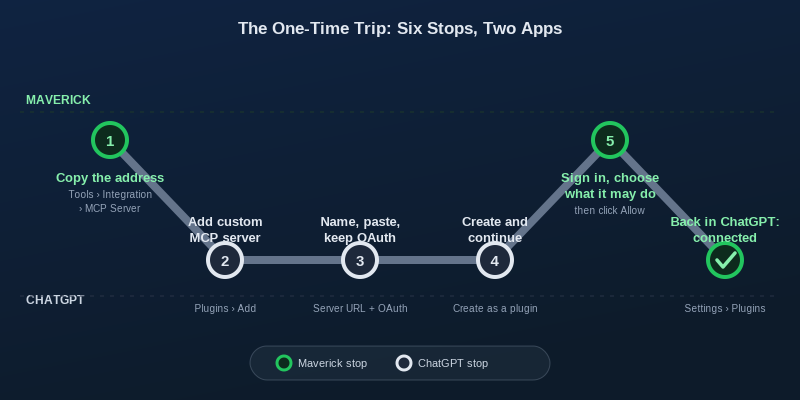
The map shows the one-time trip: two stops are in Maverick, four are in ChatGPT, and you finish back in ChatGPT.
How This Differs From the Claude Setup
| Topic | ChatGPT | Claude |
|---|---|---|
| Where you add it | Plugins, then Add, then Add custom MCP server | Plugins, then Add, then Add custom connector |
| Setup form | Name, optional description, Server URL, and OAuth, plus a risk acknowledgment | Name and address, then accept the detected sign-in settings |
| Turning it on in a chat | Start the question with the plugin's name, or attach it with the plus button | Switch the connector on under the plus button |
| Permission control | One four-level setting for the whole plugin | A per-tool setting for each of the seven tools |
| Approving a change | An approval box and Apply proposal button in the reply, then Allow once | A tool-permission prompt, then Allow once |
Which AI Feature Do You Want?
The MCP Server works the other way around from the AI built into Maverick. AI Chat and the AI Providers setup run inside Maverick and call a model for you. With the MCP Server you work in ChatGPT, using your own ChatGPT account, and ChatGPT reaches into Maverick. Webhooks, Zapier, and OData move data in the background; this is a live conversation led by a person. See Integrations for the full list.
What Can I Ask ChatGPT?
Ask the way you would ask a coworker. ChatGPT finds the records, asks Maverick to do the arithmetic, and tells you the answer.
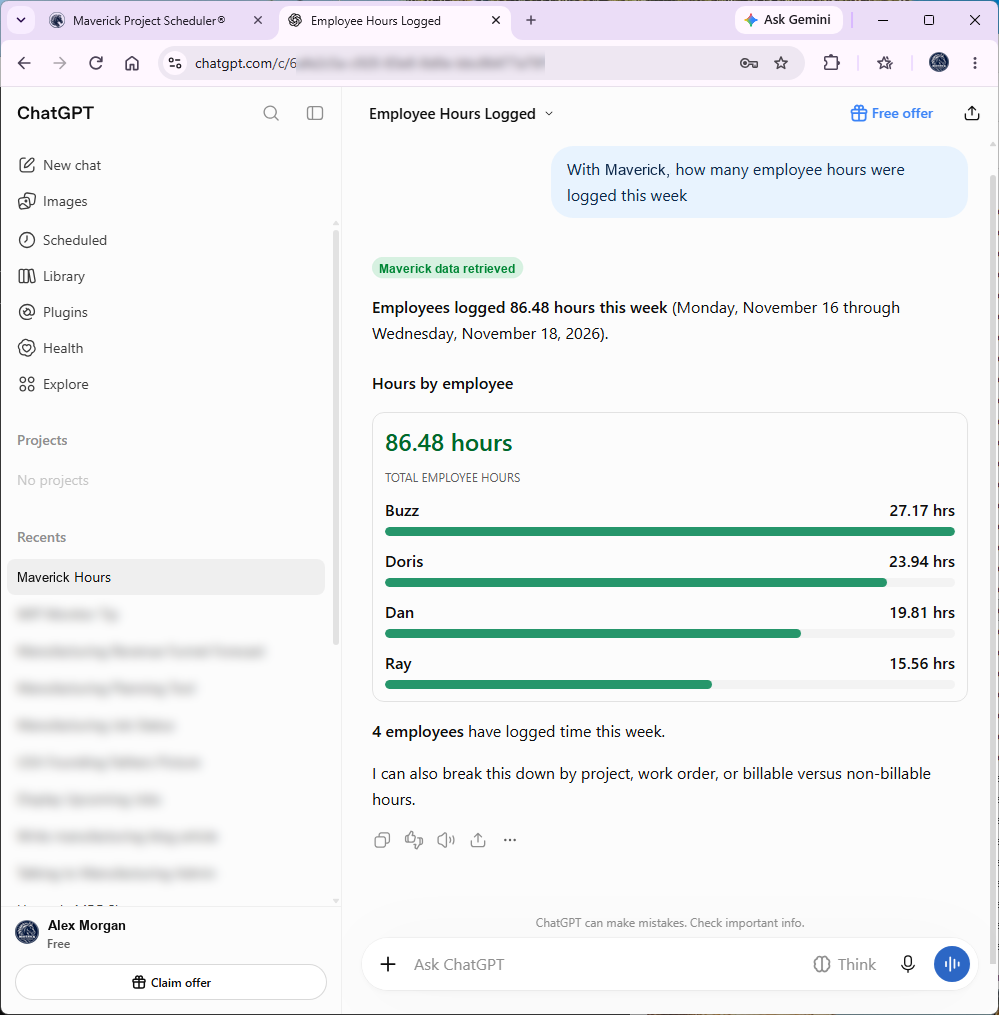
With Maverick, how many employee hours were logged this week?
You get a total plus hours by employee, drawn from live data.
Which tasks on project 10200 are due this week?
A list of the matching tasks with their dates.
Compare planned hours with hours worked on each task in this project.
A side-by-side table built from your tasks and time logs.
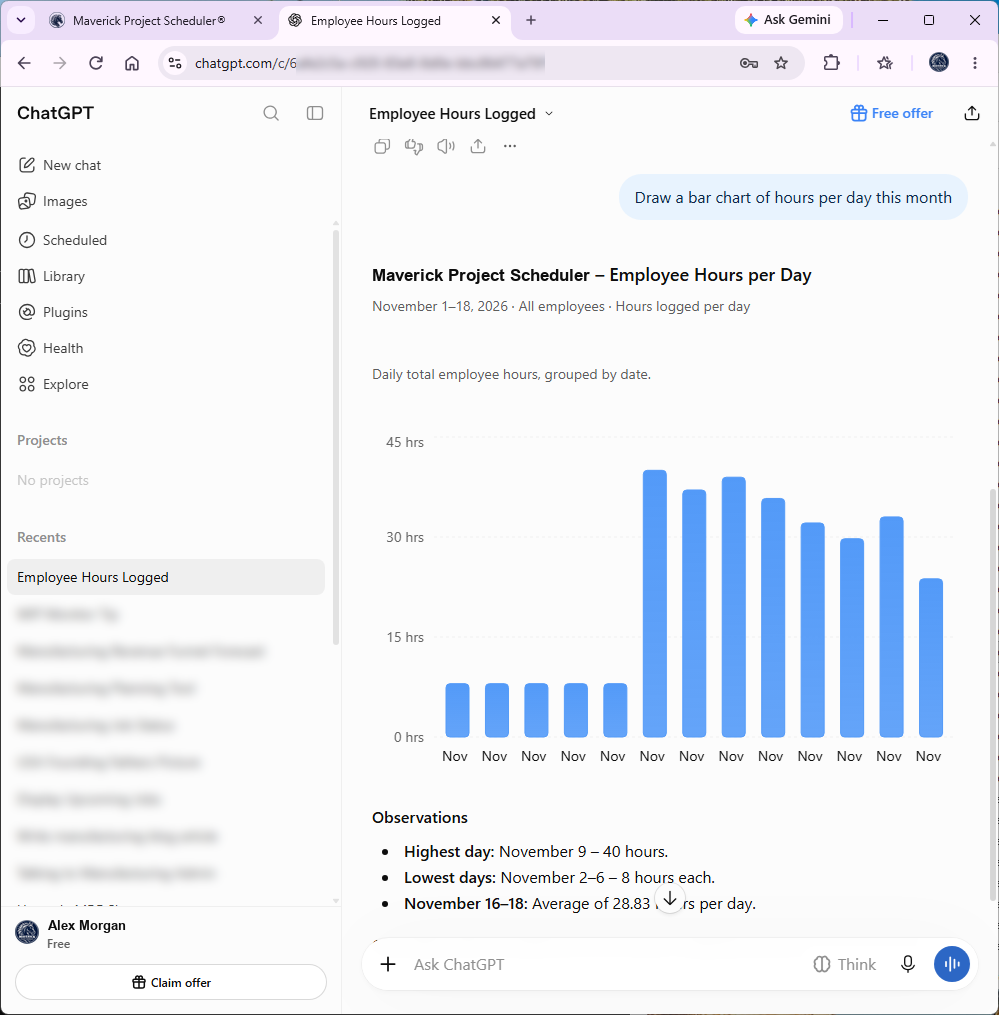
Draw a bar chart of hours per day this month.
A chart ChatGPT builds from the numbers it just looked up.
Changes, With Your Approval
ChatGPT can propose edits to project tasks and show you exactly what would change before anything is saved. It can work on:
- Progress and status: percent complete and completed
- Schedule: dates, planned hours, and the order of tasks
- Links between tasks: predecessors and successors
- Details: billable flag, category, subproject, assignments, and description
- New work: new tasks and projects, or a copy of a project or subproject, when you allow it (up to 25 new tasks per proposal)
It does not change time logs, expenses, or invoices, cannot edit an existing project's own settings, never deletes or merges records, and does not export files or send email on its own.
Before You Start
- A Maverick cloud account. On-premise installs are not supported.
- The Access to AI right for whoever connects, the same right AI Chat uses. An administrator sets rights in Users and Organization.
- An administrator login. By default only an administrator can approve a ChatGPT sign-in. If you are not one, ask an administrator to connect.
- A ChatGPT account that can add custom MCP servers. This is a ChatGPT feature, so check OpenAI's Help Center for current plan and workspace details. In a team or business workspace an owner may need to allow custom servers first.
- Your connector address from the MCP Server dialog. It contains your own Customer ID, so always copy it rather than typing it.
Connecting as an administrator? ChatGPT acts as whoever signs in, so an administrator sign-in gives it an administrator's visibility. Maverick warns you on the sign-in page. If that is more than you want, hide cost fields and user names when you connect.
Connect ChatGPT, Stop by Stop
You sign in with your own Maverick login. There is no key to copy and no client ID or secret to type.
Stop 1 — In Maverick: Copy the Connector Address
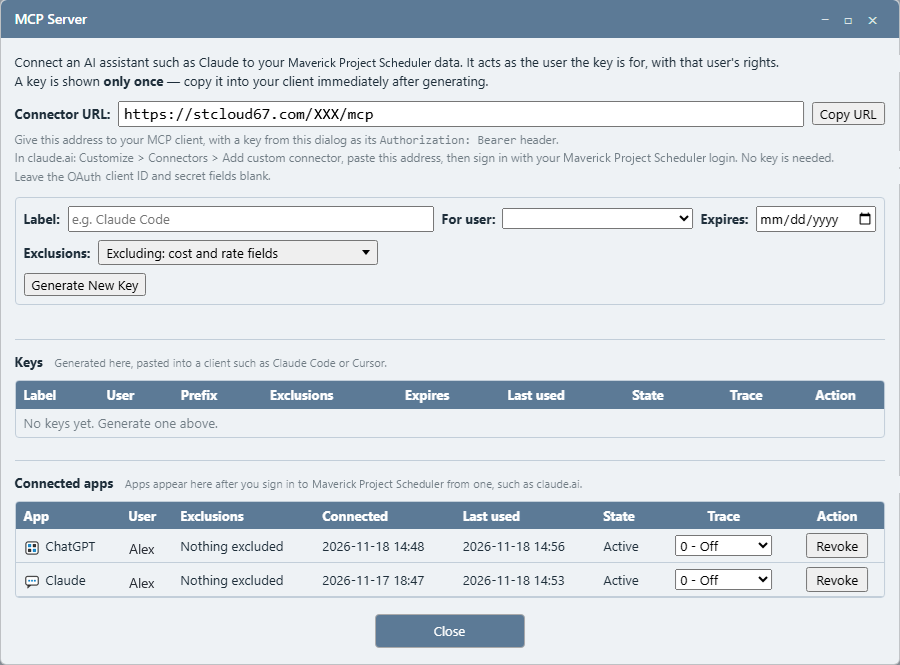
Open the Tools ribbon, click the Integration dropdown, and choose MCP Server. In the dialog, click Copy URL next to the Connector URL.
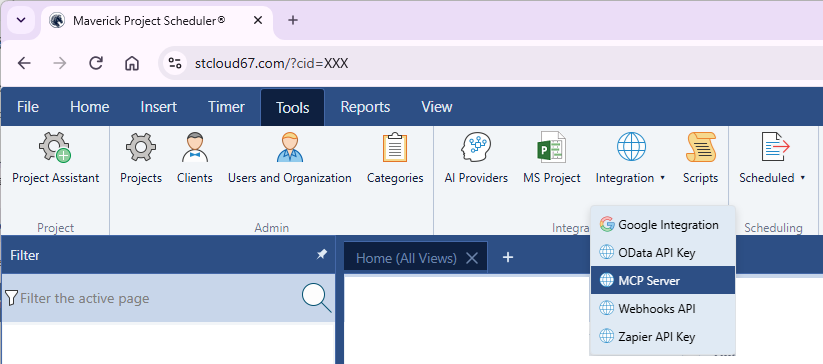
Use your own Customer ID. The address has the form https://stcloud67.com/XXX/mcp, where XXX stands for your Customer ID. The screenshots here show XXX on purpose. Copy the address from your own dialog rather than typing a number from a picture.
Stop 2 — In ChatGPT: Add a Custom MCP Server
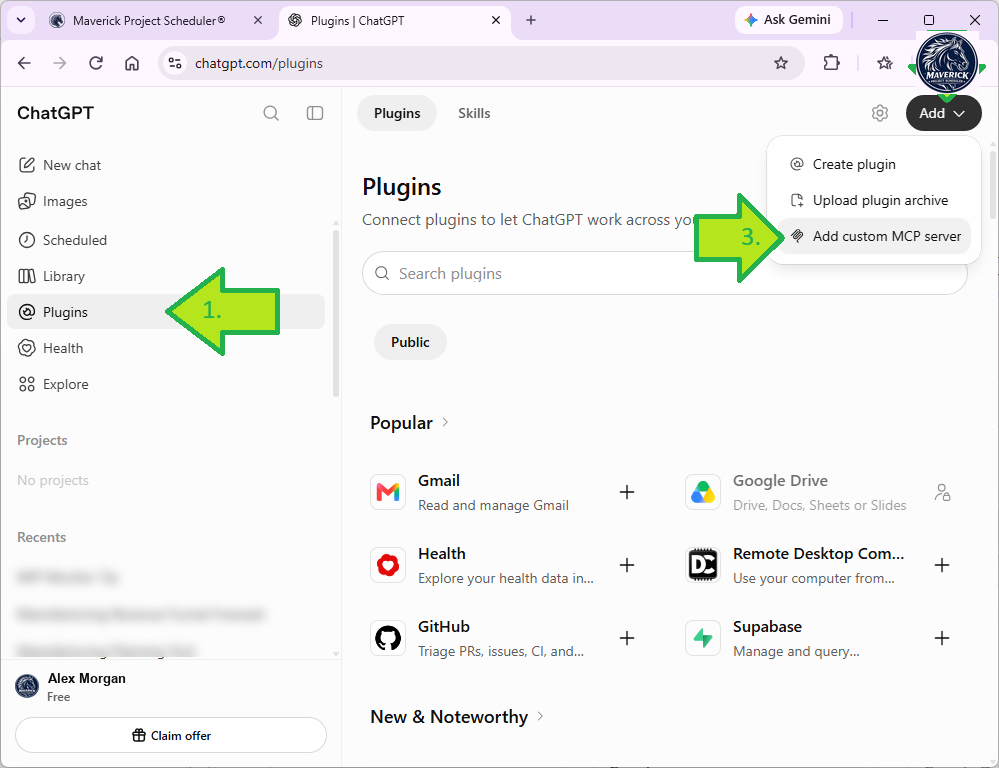
Click Plugins in the left sidebar, then Add, then Add custom MCP server. OpenAI occasionally renames menus, so if the labels differ, look for wherever ChatGPT lets you add a custom MCP server.
Stop 3 — In ChatGPT: Name It, Paste the Address, Keep OAuth
Fill in the dialog:
- Name: a label you will recognize, such as Maverick Project Scheduler.
- Description (optional): for example, Query and update Maverick projects.
- Connection: leave it on Server URL and paste the Connector URL you copied.
- Authentication: leave it on OAuth, so each person signs in with their own Maverick login.
- Advanced OAuth settings: leave them alone. You do not need a client ID or secret.
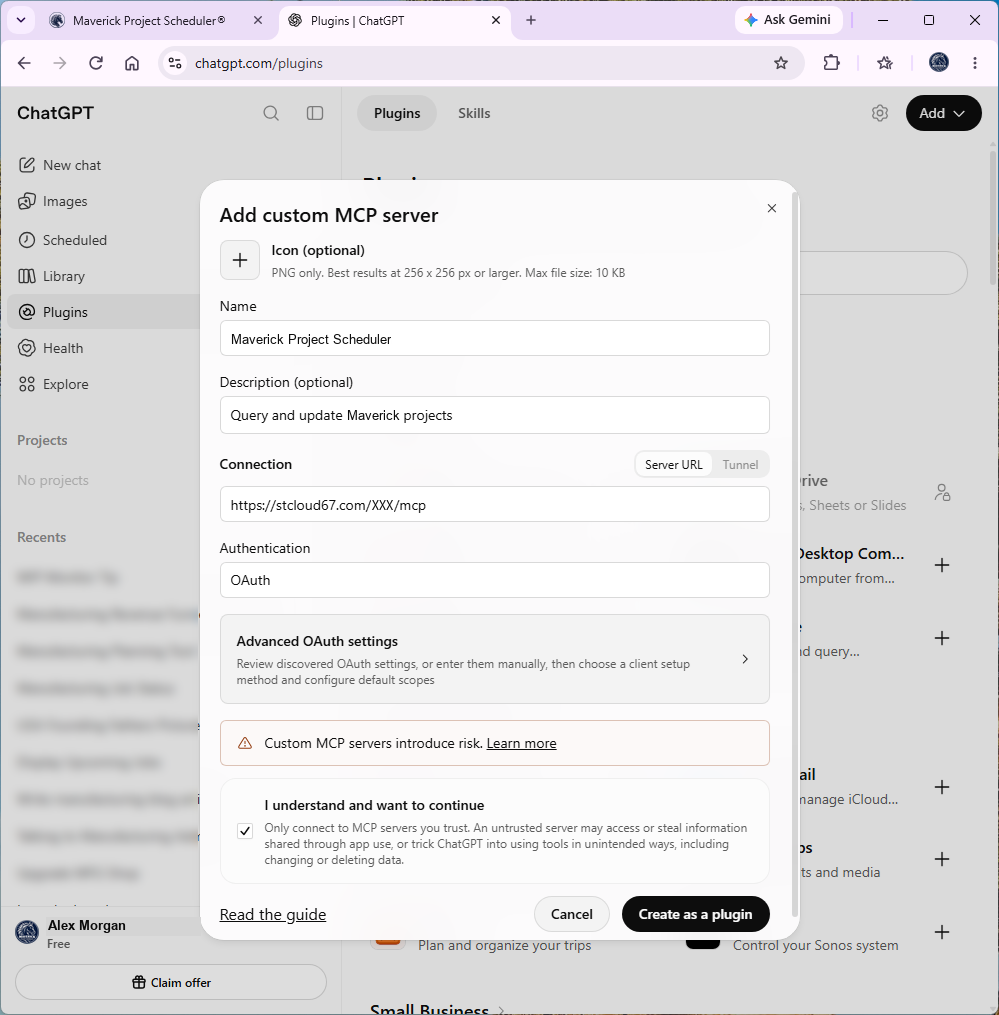
The name and description are only labels in your own plugin list. The address must be the exact Connector URL from your Maverick dialog.
Stop 4 — In ChatGPT: Confirm, Create, and Continue
ChatGPT shows a red notice that custom MCP servers introduce risk. It appears for every custom server, and the advice is to connect only to servers you trust. This address is your own Maverick account. Tick I understand and want to continue, click Create as a plugin, then click the Continue button that carries your plugin's name. That opens a Maverick page in your browser.
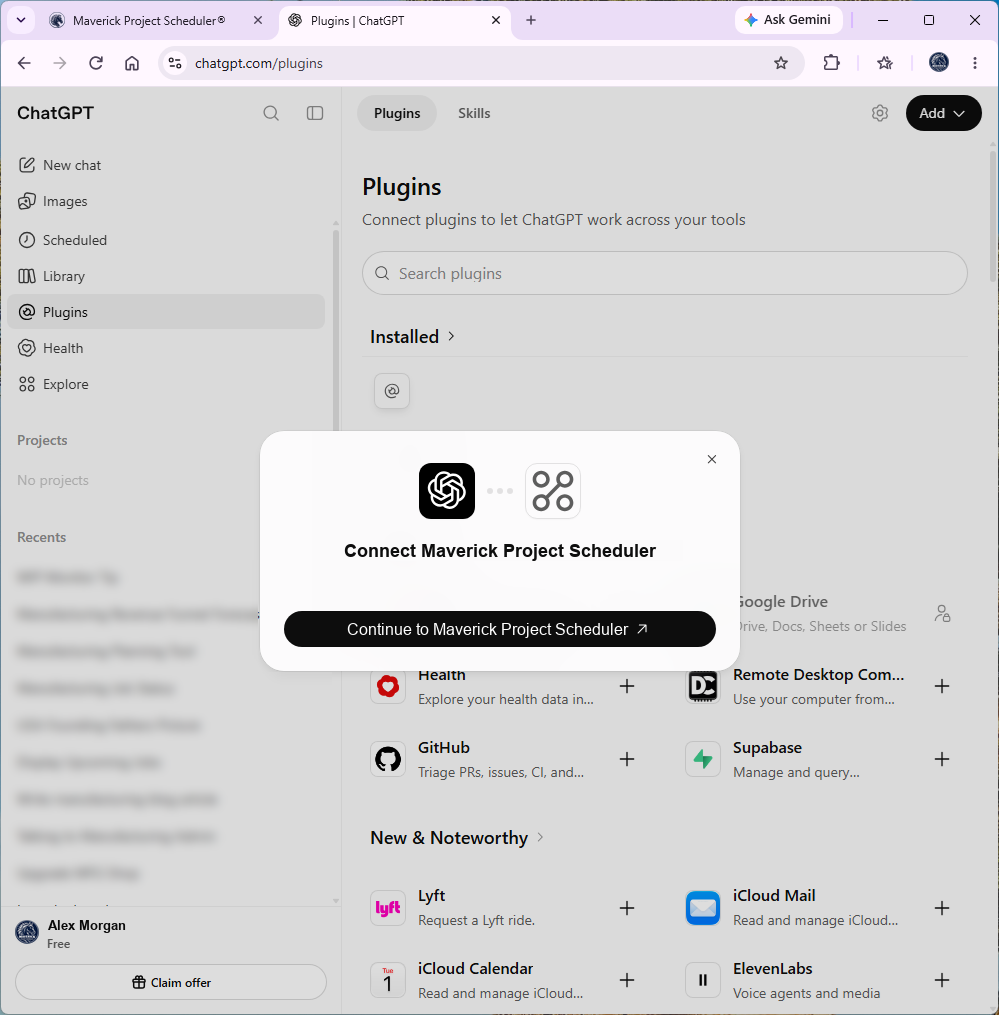
Stop 5 — In Maverick: Sign In and Choose What ChatGPT May Do
The page is titled Connect an app and names ChatGPT as the app asking. Enter your Maverick username and password, choose what ChatGPT may do, and click Allow. If you sign in as an administrator, a yellow note reminds you that the connection gets an administrator's visibility. The choices are fixed for that connection; to change them later, disconnect and connect again.
- Read — ChatGPT can look things up but can never propose a change.
- Read and write — it can also propose changes to tasks. Nothing is saved until you approve it.
- Hide cost and rate fields — client and salary costs and rates are withheld, even if your own rights allow them. A good choice unless you want cost answers.
- Hide user names — ChatGPT sees stand-ins such as User 1 instead of real employee names.
- Allow it to create and copy projects and tasks — lets it propose brand-new tasks, projects, and copies. Needs Read and write, and you still approve each proposal.
Stop 6 — Back in ChatGPT: Confirm It Is Connected
You land back in ChatGPT. Open Settings, then Plugins, and click your plugin. Under Connected accounts you should see your account marked Primary, and the About list shows the address and Authorization used: OAuth.
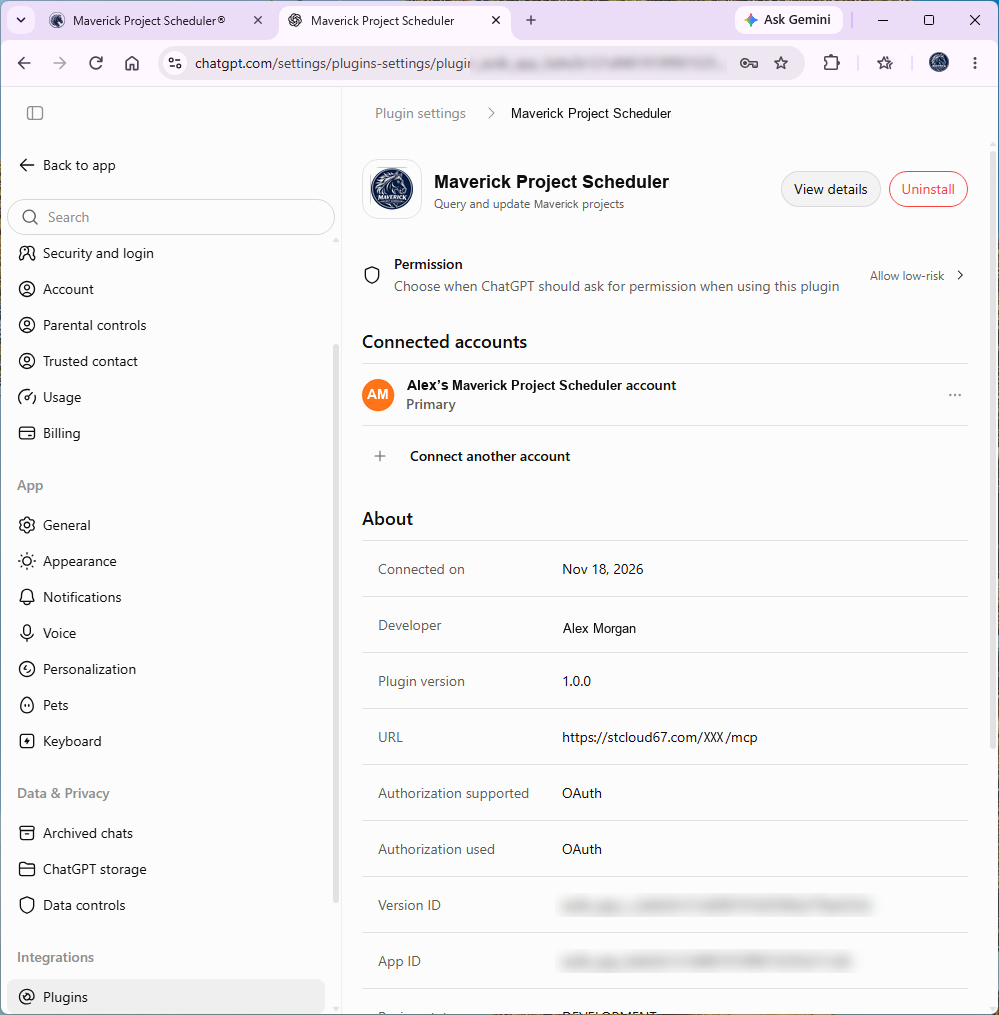
A matching ChatGPT row also appears under Connected apps in the Maverick MCP Server dialog.
Staying signed in: ChatGPT keeps the connection alive in the background. After about 30 days unused, or roughly six months in all, it asks you to sign in again. If you revoke the connection, ChatGPT loses access immediately.
Ask Your First Question
Open a new chat and start with the plugin's name. In testing that was enough for ChatGPT to find the connection; there was no switch to turn on.
ChatGPT labels the reply as data retrieved from the plugin, totals the week's hours, and shows a bar for each employee. Totals come from Maverick, not from ChatGPT's own arithmetic.
It builds a chart from the numbers it just looked up, then adds a few observations about the busiest and quietest days.
Want to Be Certain It Uses Maverick?
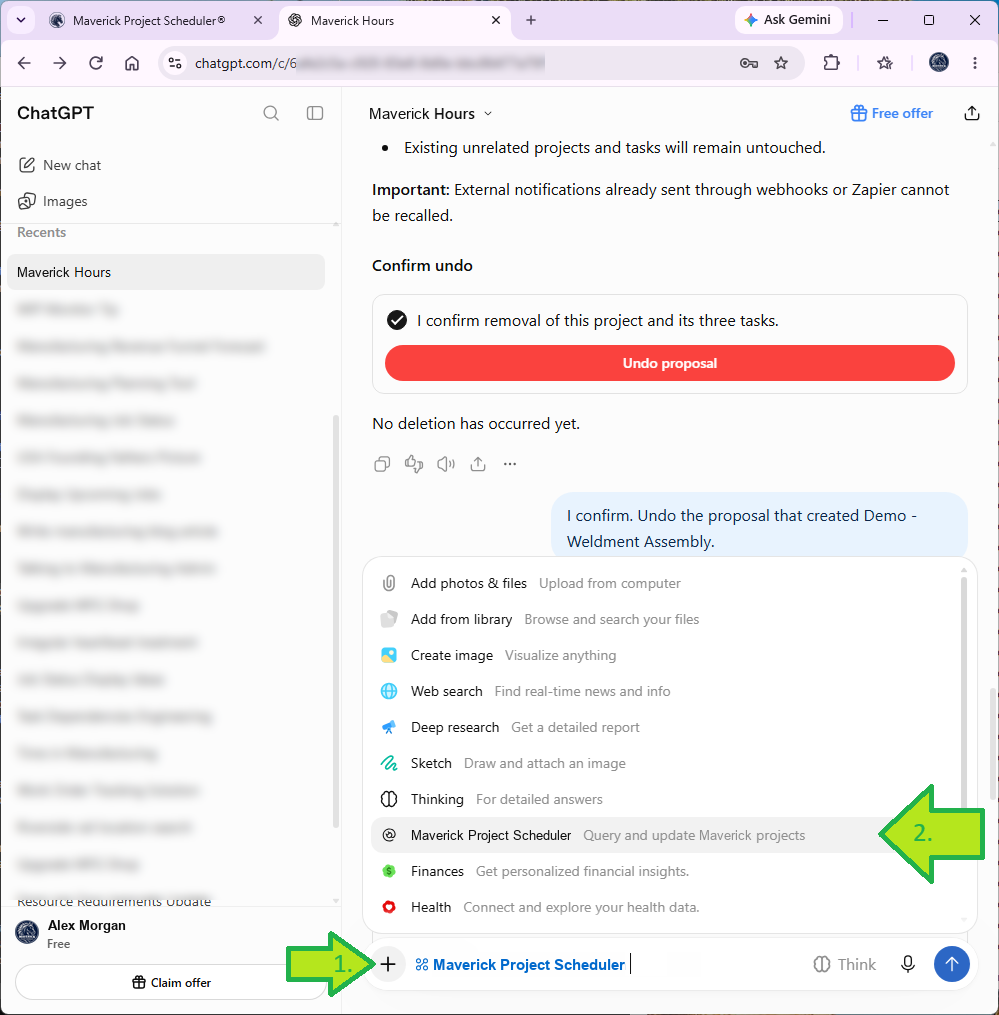
Attach the plugin yourself: click the + button in the message box and choose your plugin. A blue chip appears in the box, and the next message goes out with the plugin attached. Naming it in your question usually does the same job.
Changing Tasks: A Conversation With Two Clocks
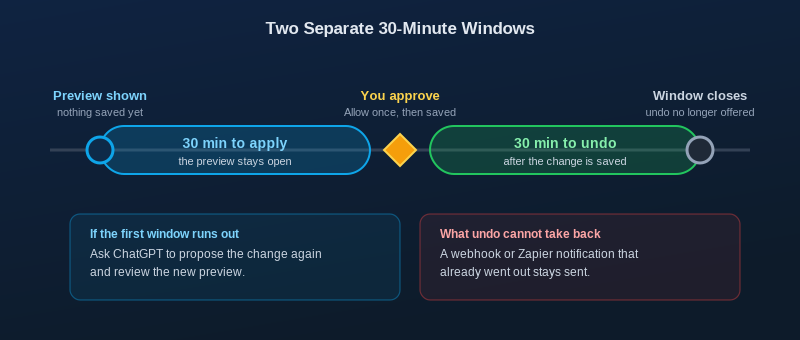
Reading is harmless, but changing your schedule is not. So every change runs on two separate 30-minute windows, and nothing is written until you approve the apply.
Here is a worked example: ChatGPT sets up a small project with three linked tasks, and then you undo it.
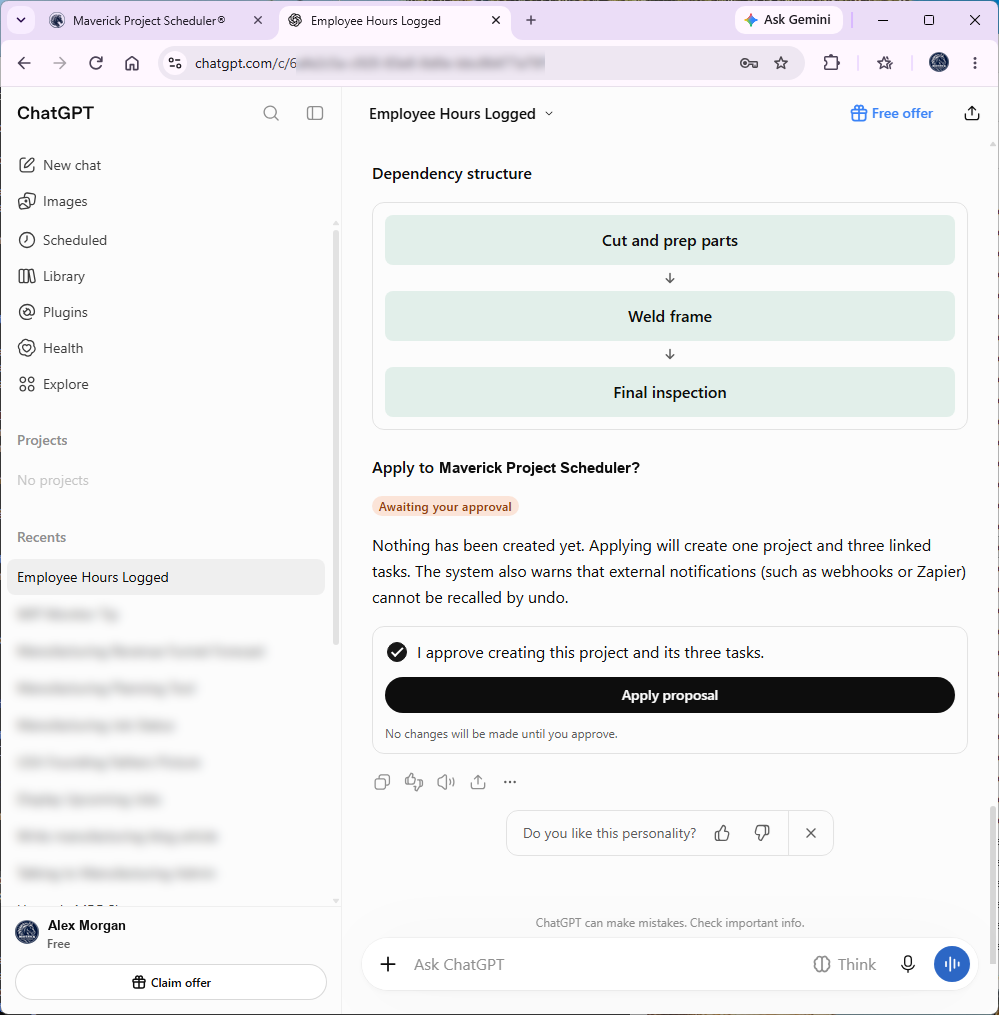
It draws what it plans to create, here including the order of the tasks. It then says Awaiting your approval and Nothing has been created yet. A proposal writes nothing; it only checks the request and builds the preview. Read it carefully.
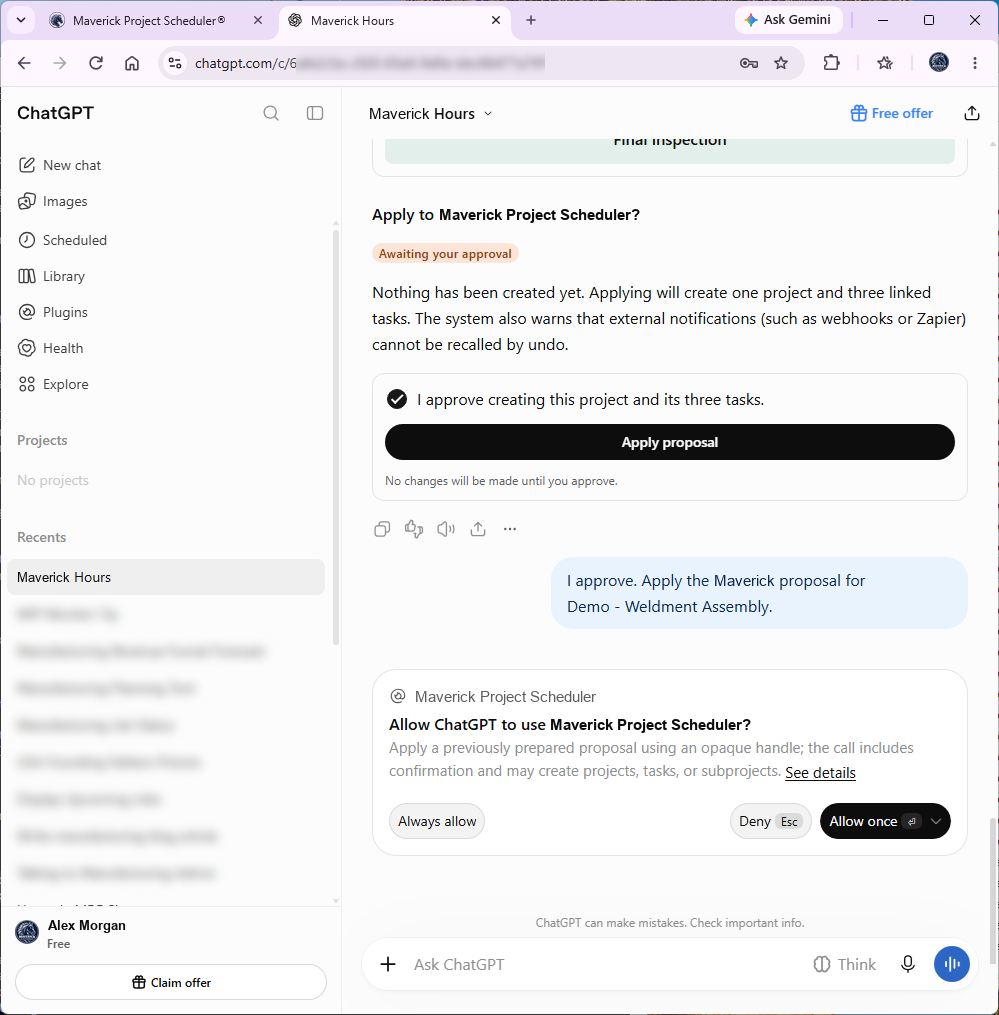
It asks to use the plugin to apply the proposal. Click Allow once. (Always allow skips this stop in future; see the permission steps below.)
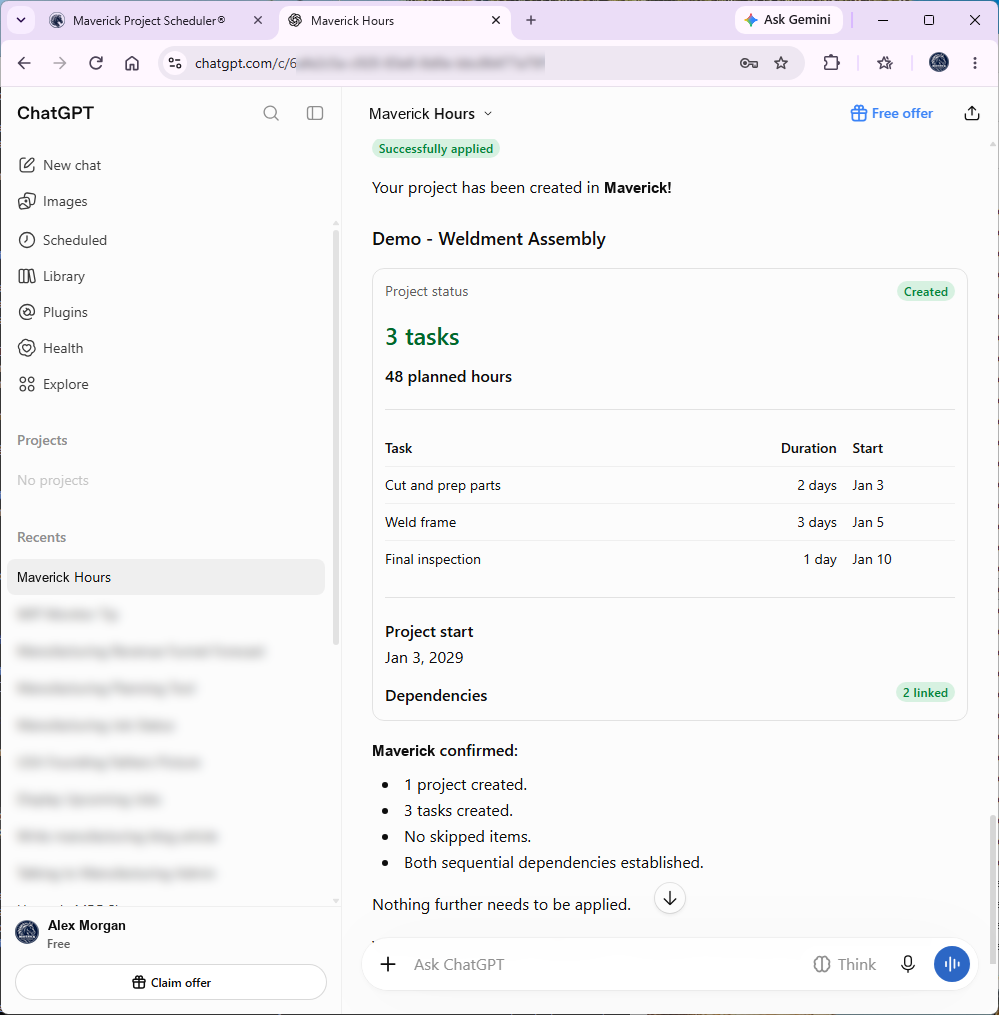
It reports Successfully applied with a summary of the project, its tasks, planned hours, and links, and says what Maverick confirmed: one project, three tasks, 48 planned hours, and two links.
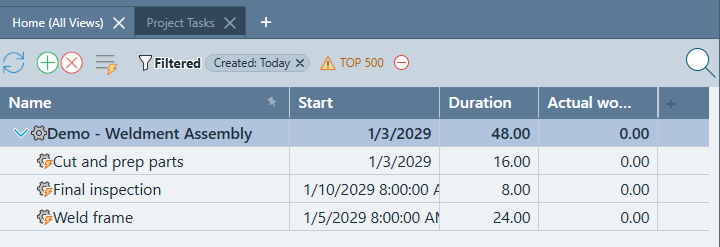
The project now exists in Maverick, and everyone with access sees it like any other record. In Project Tasks it totals 48 hours (16 + 8 + 24).
It shows what undoing would remove, including the project, each task, and the links between them, and says No deletion has occurred yet. Tick the confirmation and click Undo proposal.
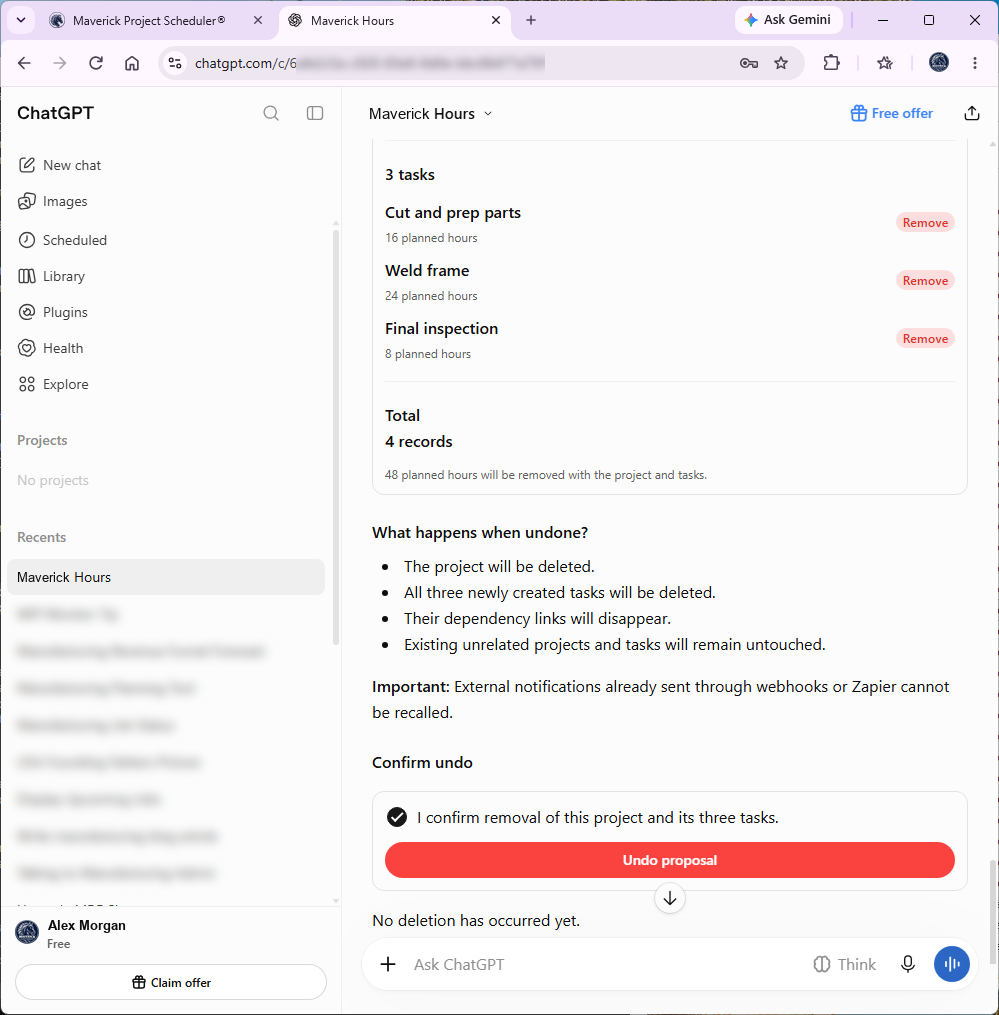
Undone: the project and its tasks are gone, and nothing else was touched.
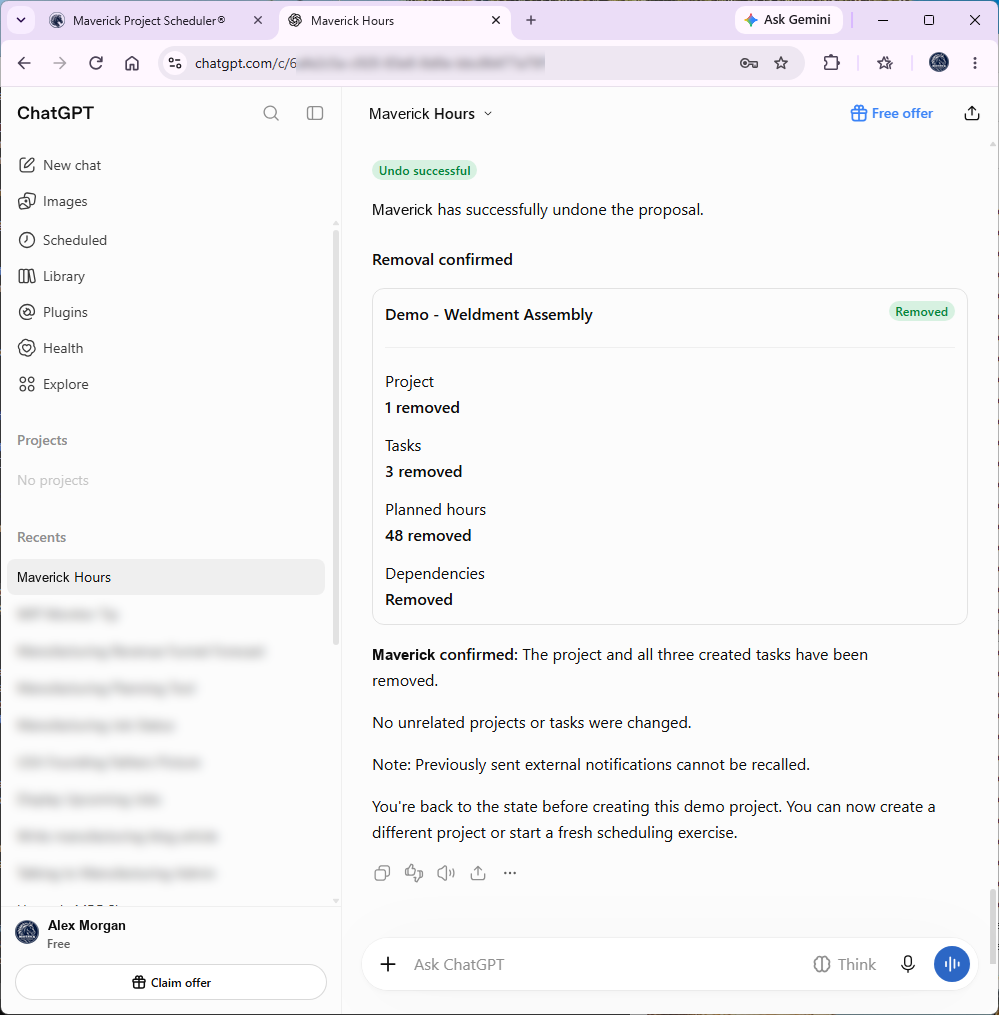
Undo cannot recall notifications. If a change already fired a webhook or a Zapier automation, undo does not take that back. ChatGPT warns you before applying anything that cannot be fully reversed.
Good to Know
- One proposal at a time. A new proposal replaces the open one. If it expired or you were disconnected, ChatGPT says it is no longer available; ask it to propose again.
- Big previews are summarized. The preview lists up to 25 changed rows and tells you how many are not listed.
- Large schedules take rounds. A proposal adds up to 25 new tasks. For 60 tasks, ChatGPT builds the project with the first 25, then attaches the next batches, asking for approval each time.
- Your rights still apply. Adding tasks needs the right to create project tasks. Starting or copying a whole project needs an administrator who can administer projects.
- Projects can opt out. A project whose AI-updates setting is off is skipped, and ChatGPT says which rows it could not change.
- Review every preview. ChatGPT can make mistakes, and the preview is your chance to catch them.
ChatGPT's Permission Steps
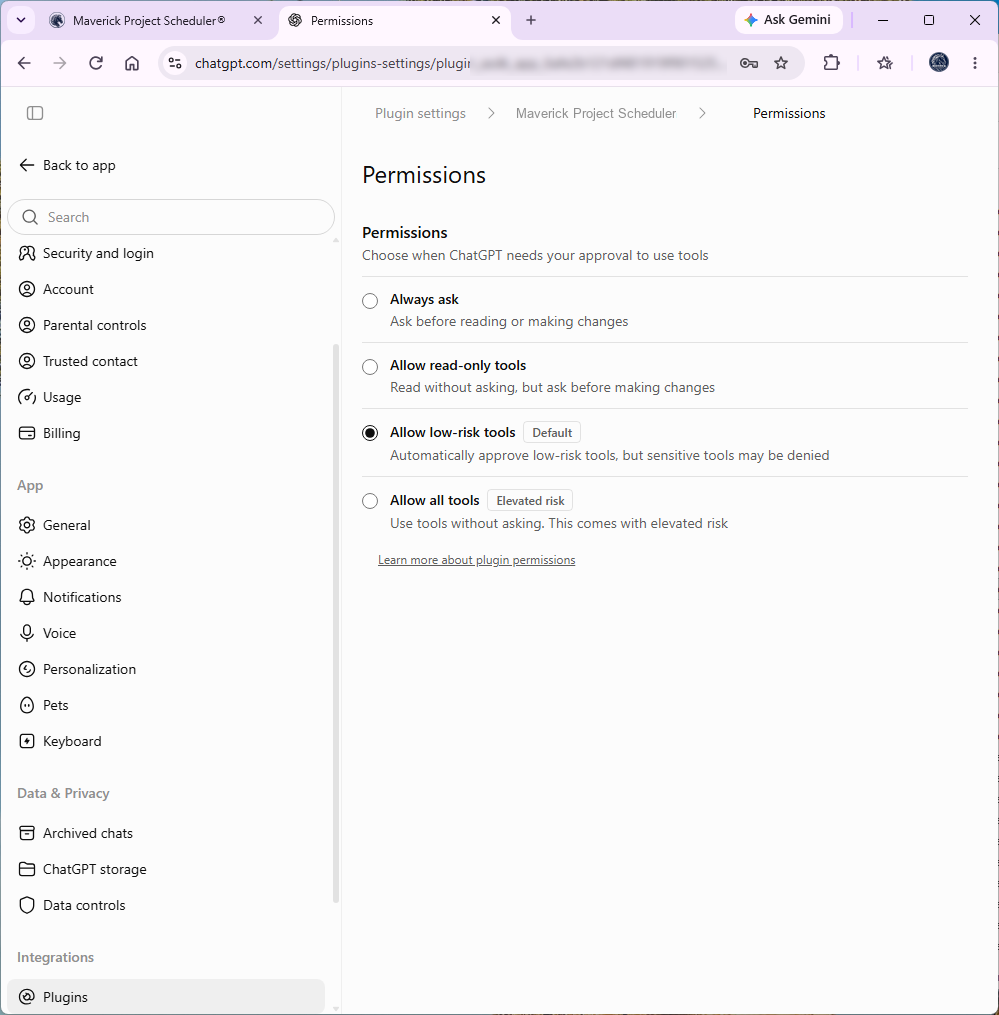
ChatGPT decides when to stop and ask before using a plugin's tools from one setting for that plugin. Find it in Settings, then Plugins: open your plugin and click Permission.
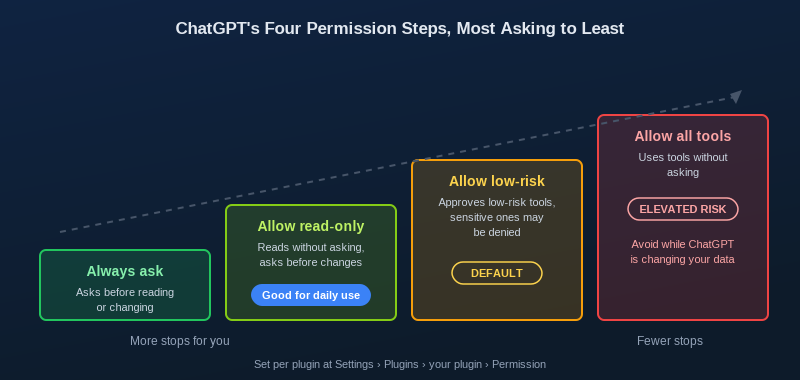
| Level | What ChatGPT does |
|---|---|
| Always ask | Asks before reading or making changes. The most cautious choice; expect a prompt on every lookup. |
| Allow read-only tools | Reads without asking, but asks before making changes. |
| Allow low-risk tools (default) | Approves low-risk tools automatically; sensitive tools may be denied. In our test at this level ChatGPT still stopped for approval before applying a change. |
| Allow all tools | Uses tools without asking. ChatGPT labels this Elevated risk. |
Recommendation: avoid Allow all tools while ChatGPT is changing your data, so every change keeps its extra stop. Choosing Always allow on a permission prompt works the same way, so use Allow once for applying and undoing.
The Seven Tools Behind the Scenes
Maverick offers ChatGPT seven tools. The first four never write anything.
| Tool | Changes data? | What it does |
|---|---|---|
| Find entities | No | Turns a name you type, such as a project, task, employee, or client, into the right record. |
| Get schema | No | Tells ChatGPT today's date, who you are, and which kinds of data you can see. |
| Query | No | Reads rows or totals, such as hours by project or tasks due this week. |
| Propose changes | No | Builds a preview of a change. It writes nothing. |
| Apply proposal | Yes | Saves an open proposal after you have seen the preview and agreed. |
| Cancel proposal | No | Throws away an open proposal without changing anything. |
| Undo proposal | Yes | Reverses an applied proposal within 30 minutes of applying it. |
Limiting What ChatGPT Can See and Do
Several layers keep ChatGPT inside the lines. Each one can only narrow what it reaches, and none of them widens it.
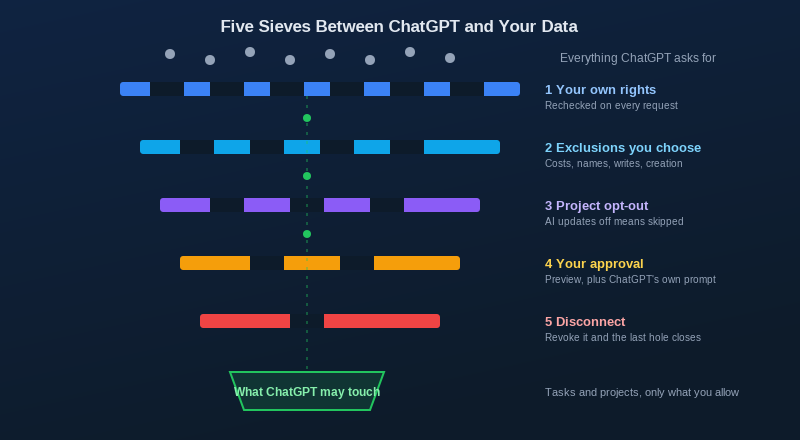
- Your own rights. The connection is you. If you may not view salary rates, or only see projects you are assigned to, neither can ChatGPT. Rights are checked on every request.
- Exclusions you choose when you connect (listed below).
- Project-level opt-out. A project whose AI-updates setting is off cannot be changed, whatever the connection allows.
- Your approval. Every change needs a preview and your approval, and ChatGPT's own permission setting can add another stop.
- Disconnecting. You can revoke the connection at any moment.
| Exclusion | Effect |
|---|---|
| Cost and rate fields | Client and salary costs and rates are withheld, even from a user whose rights allow them. |
| User names | ChatGPT sees stand-ins such as User 1 instead of real names. |
| Database writes (Read only) | No changes of any kind. ChatGPT is never offered the tools that change data. |
| Database record creation | ChatGPT may edit existing tasks but not create or copy tasks and projects. Excluding writes also excludes creation. |
Exclusions are chosen at connect time. To change them, revoke the connection and connect again with different choices.
Do You Need a Key?
No. ChatGPT on the web signs in with your Maverick login, as described above. Tools that run on your own computer, such as Claude Code and Cursor, can send a key instead; creating, copying, and revoking keys is covered in the key section of the Claude guide.
Disconnecting and Revoking
You can cut off ChatGPT from either side, but one side is the one that counts.
| Where | How | Effect |
|---|---|---|
| In Maverick (recommended) | Tools, Integration, MCP Server. Under Connected apps, find the ChatGPT row and click Revoke. | Ends the connection on Maverick's side immediately. Open, unapplied proposals are forgotten. |
| In ChatGPT | Settings, Plugins, open your plugin, and click Uninstall (or use the three dots beside the connected account). | Removes the plugin from your ChatGPT account. Revoke in Maverick as well, because that is what actually shuts the door. |
A revoked connection stays in the list, dimmed and marked Revoked, so you keep a record. To connect again, repeat the setup stops. You get a fresh consent page, which is also your chance to choose different exclusions.
When Something Does Not Work
ChatGPT answers without using Maverick
Name the plugin in your question, or click + and choose it. Then check Settings, Plugins to make sure it is installed.
Sign-in says the username or password is wrong
Check both. Several wrong tries in a row lock sign-in for a while, so wait before trying again.
Sign-in is refused with the right password
The account may lack the Access to AI right, or may not be an administrator (a requirement by default). Ask an administrator.
That proposal is no longer available
It expired after 30 minutes, you were disconnected, or the connection sat idle. Ask ChatGPT to propose the change again and review the new preview.
No cost or rate answers
Cost and rate fields are hidden on this connection, or your own rights do not allow them. Revoke and reconnect without that exclusion.
User 1 and User 2 instead of names
User names are hidden on this connection. Reconnect without that exclusion if you want real names.
ChatGPT asks you to sign in again
The connection went unused for about 30 days or reached its roughly six-month limit. Connect again from the plugin page.
A prompt on every single lookup
The plugin's permission is set to Always ask. Change it to Allow read-only tools in Settings, Plugins.
ChatGPT skipped some rows
The project's AI-updates setting is off, or your rights do not allow that change. ChatGPT lists what it skipped and why.
Slow, or a rate-limit message
Requests are limited to 120 per minute. Wait a moment and try again.
Is It Safe? Protections and Limits
What Protects You
- It acts as you, with your rights, and there is no separate permission system. Rights are rechecked on every request, so removing a right or revoking a connection takes effect on the very next one.
- Changes are two steps. A preview, then an apply you approve. Even instructions hidden in a task note cannot change anything without that approved apply.
- Your Maverick password stays in Maverick. You type it only into the Maverick sign-in page, never into ChatGPT, and everything travels over HTTPS.
- Sign-in is rate-limited, and failed attempts look alike, so nobody can use them to guess which user names exist.
- There is a record. Applying and undoing changes are always logged, and an administrator can turn on more detailed activity logging for a connection.
Limits to Know About
- ChatGPT edits and creates tasks and projects only. Time logs, expenses, invoices, and existing project settings are read-only to it.
- It never deletes or merges anything, so removing records is always done in Maverick itself.
- It is available for Maverick cloud accounts only, and an AI assistant can misunderstand a request, which is why every change shows a preview first.
- ChatGPT is a separate service from OpenAI with its own account, plans, and menus. Those can change; the Maverick side described here stays the same. This is an independent guide from Maverick Development, and OpenAI is not affiliated with Maverick Project Scheduler.
Quick Answers
Keep Going
- Connect Claude to Maverick — the same doorway for Claude, plus keys for Claude Code and Cursor.
- AI Chat — the assistant that lives inside Maverick.
- Integrations — Power BI, Zapier, webhooks, and more.
- Gantt Chart & Project Tasks — the tasks ChatGPT can read and change.