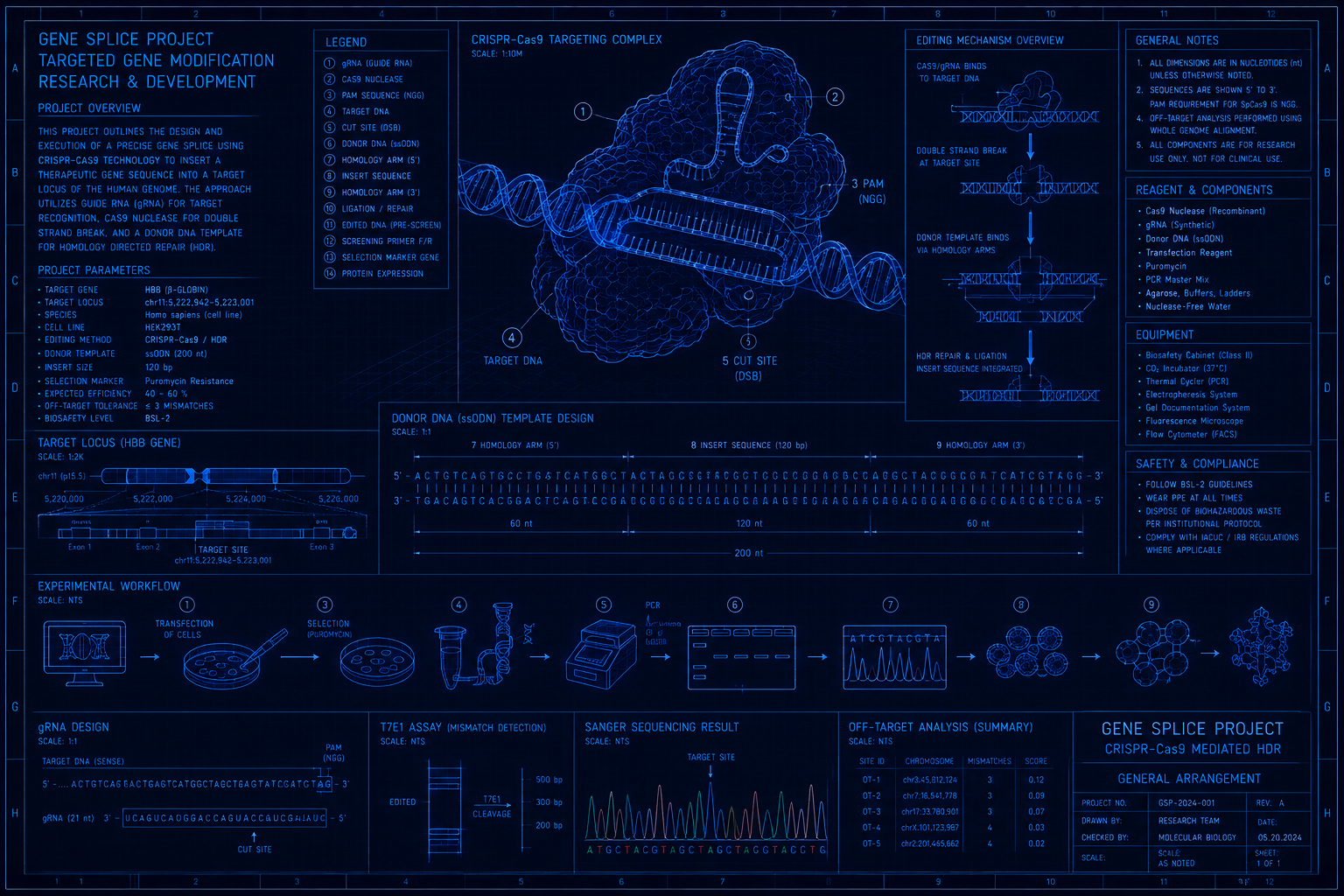
The Study Design
Every other blueprint in this series builds a schedule inside Maverick, one click at a time or one AI prompt at a time. This one builds the schedule outside Maverick first — as a single block of plain text — and hands the whole thing to the Project Assistant in one paste. The fictional program is the HBB Locus Correction Program: a preclinical CRISPR-Cas9 gene-editing R&D effort that directly corrects the HBB (beta-globin) gene at chr11:5,222,942–5,223,001 using a synthetic guide RNA, a recombinant Cas9 nuclease, and a single-stranded oligodeoxynucleotide (ssODN) donor template — carried from target design through clonal screening, off-target safety analysis, xenograft efficacy testing, and a pre-IND regulatory package.
A gene-editing program is a good fit for the paste-once technique because the schedule is not something you improvise. A wet-lab protocol is already a fixed, well-known sequence before you ever open Maverick — you do not need an AI to suggest what order to run a T7E1 mismatch assay in, and you do not need to click through a dialog 190 times to enter it. What you need is a way to describe the entire program, its nested resource groups, and its dates in one shot. That is exactly what Maverick's tagged task-list text format is built for.
There is no concrete to pour and no crane to schedule around in this blueprint. Every constraint is either a committee calendar, a reagent lead time, a sequencing turnaround, or the fixed biology of a mouse. That single difference reshapes almost everything else about how this schedule behaves — which is the whole point of building it.
Fun Fact: This Program Takes the Harder Path on Purpose
The first CRISPR-based gene-editing therapy to reach the market, Casgevy (exagamglogene autotemcel), was approved by the FDA in December 2023 for sickle cell disease and in January 2024 for transfusion-dependent beta-thalassemia — both diseases rooted in the same HBB gene this blueprint targets. But Casgevy does not correct HBB directly. It uses CRISPR-Cas9 to cut a regulatory enhancer near a different gene, BCL11A, letting the cut heal itself through the cell's ordinary NHEJ repair pathway. That disruption switches a fetal hemoglobin gene back on to compensate for the faulty adult hemoglobin — an indirect, comparatively efficient fix.
The fictional program in this blueprint takes the harder road: direct HDR-based correction of the HBB gene itself, using a donor ssODN template as the repair blueprint. HDR only runs during the S and G2 phases of the cell cycle and competes with the far more active NHEJ pathway for every double-strand break, which is why this program's task list includes an entire donor-template design phase and a heavier clonal-screening burden that a simple enhancer-disruption program would not need. It is scientifically the less traveled path — which is exactly why it is a richer schedule to practice on.
| Aspect | Casgevy (Real, FDA-Approved) | This Blueprint's Fictional Program |
|---|---|---|
| Editing mechanism | NHEJ disruption of a BCL11A enhancer | HDR-based direct correction of HBB |
| Repair pathway efficiency | High — NHEJ is the cell's default repair route | Lower — HDR competes with NHEJ and needs a donor template |
| Cell source | Patient's own CD34+ HSCs, autologous | HEK293T research line, preclinical model |
| Program stage | FDA approved and commercially available | Fictional — preclinical, pre-IND stage |
| List price | Publicly reported at more than $2 million per patient | Not applicable — R&D program only |
For background on how CRISPR-Cas9 editing works and where it is used in approved and investigational therapies, see the FDA Cellular & Gene Therapy Products page.
Research Skills You'll Build
Six things this blueprint teaches that no other blueprint on this site covers.
Tagged Task-List Syntax
Learn the {duration:}, {start:}, and {user:} tag format that builds an entire project structure from one pasted block of text.
Nested Workgroup Creation
Force-create a three-level workgroup hierarchy — Research Staff, Reagents and Consumables, Lab Equipment — without ever opening Home → Users first.
Three Resource Types in One Paste
Humans, machines, and materials created and correctly typed in the same text block, guarded by a default that protects your license count.
The One Link That Matters
Wire the single Finish-to-Start dependency where a failed safety check would send a clone back to screening instead of forward to efficacy testing.
Baseline Against Regulatory Risk
Lock a baseline where the biggest variance driver is a committee review calendar, not the weather.
Critical Path Through a Lab Bench
Find the zero-float chain running through sequencing turnaround and mouse biology — not a crane, not a permit.
What Actually Delays a Lab Schedule
The construction and energy blueprints on this site put weather, permits, and equipment delivery on the critical path. None of those apply here. This program runs entirely inside a BSL-2 lab, and its schedule risk comes from an entirely different set of forces — worth naming explicitly before you paste a single line.
| Risk Category | Typical Construction Blueprint | This Program |
|---|---|---|
| Weather | Rain delays a foundation pour | Not applicable — indoor, climate-controlled lab |
| Committee approval | Building permit, days to weeks | IBC and IACUC protocol review, 14–21 days each, before any rDNA or animal work can start |
| Procurement lead time | Steel, transformers, weeks to months | Custom gRNA and ssODN synthesis, 3–4 weeks; recombinant Cas9 nuclease, 8 weeks |
| Go/no-go gate | Inspection sign-off | Off-target analysis QC gate — a failed mismatch score sends the clone back to screening, not forward |
| Biological variability | Not applicable | Xenograft engraftment rate is not fully controllable — the monitoring window is fixed by mouse biology, not by adding staff |
Protocol 1: Name the Program in the Project Assistant
Go to Home → Project Assistant and choose Create a project. Enter the program name — HBB Locus Correction Program (CRISPR-Cas9 Preclinical R&D) — and click Next to reach the task list step.
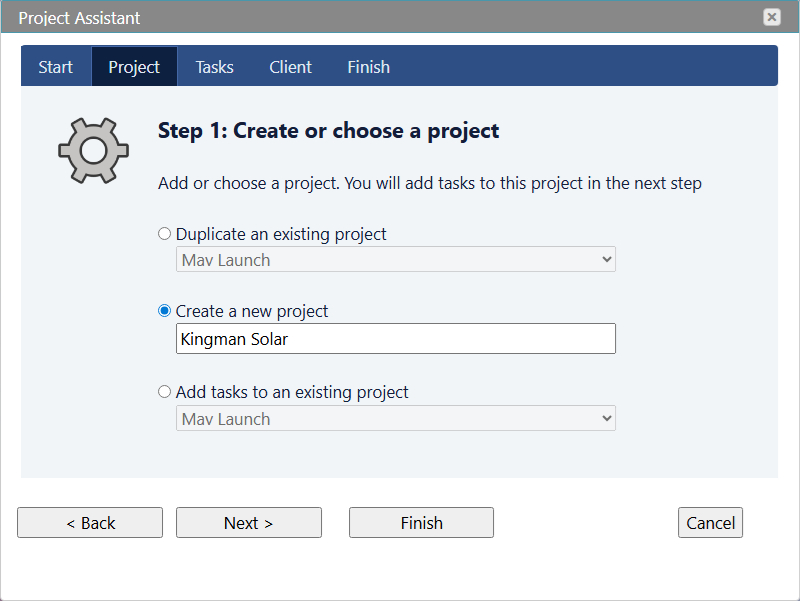
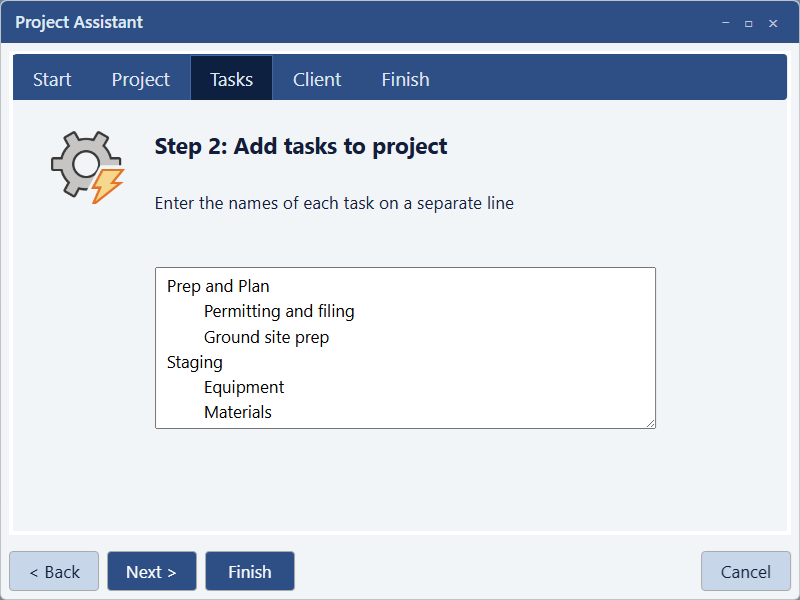
Process tip: this is the same text box the rest of the site calls the "Tasks" property editor. Whether you reach it through the Project Assistant's task list step when creating a new project, or later through a project's right-click Properties panel under the Tasks property, it is the identical tab-indented, tag-aware text field. Anything you can paste here on day one, you can also paste into an existing project's Tasks property later to add a new wave of work.
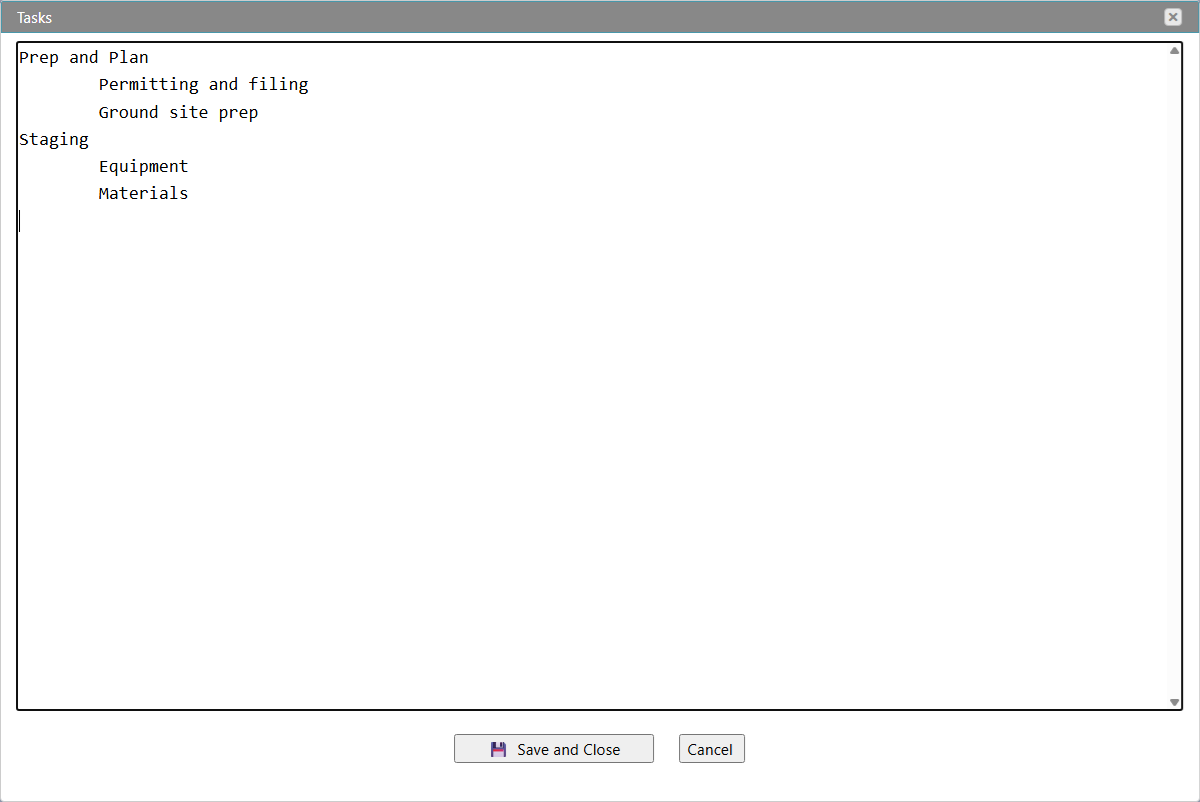
Protocol 2: Paste the Complete Task List
Everything below is one continuous block. Leading tabs set the nesting level — nine top-level phases, eighteen nested sub-groups, and 164 leaf tasks, each carrying its own duration, start date, and resource assignment tags. Select the entire block, copy it, and paste it directly into the task list field. Click Next and Maverick creates every phase, sub-group, task, workgroup, and resource in a single pass.
Copy The Text Below
Program Setup and Regulatory Foundation Institutional Approvals Draft IBC protocol for recombinant DNA and CRISPR work (BSL-2){duration:6h}{start:+900d}{user:Principal Investigator}{forceuser:true}{forcegroup:true}{usertype:human}{parent:HBB Gene Therapy Program:Research Staff} Internal PI review of IBC protocol draft{duration:2h}{start:+901d}{user:Principal Investigator}{forceuser:true}{forcegroup:true} Submit IBC protocol for committee review{duration:0.0h}{start:+902d}{user:QA/Regulatory Affairs Specialist}{forceuser:true}{forcegroup:true}{usertype:human}{parent:HBB Gene Therapy Program:Research Staff:Regulatory Affairs} IBC committee review period{duration:14d}{start:+902d}{user:QA/Regulatory Affairs Specialist}{forceuser:true}{forcegroup:true} Respond to IBC committee clarification questions{duration:3d}{start:+913d}{user:Principal Investigator}{forceuser:true}{forcegroup:true} IBC protocol approved{duration:0.0h}{start:+917d} Draft IACUC protocol for planned xenograft efficacy study{duration:8h}{start:+903d}{user:Study Director}{forceuser:true}{forcegroup:true}{usertype:human}{parent:HBB Gene Therapy Program:Research Staff} Submit IACUC protocol for committee review{duration:0.0h}{start:+904d}{user:IACUC Liaison}{forceuser:true}{forcegroup:true}{usertype:human}{parent:HBB Gene Therapy Program:Research Staff:Regulatory Affairs} IACUC committee review period{duration:21d}{start:+904d}{user:IACUC Liaison}{forceuser:true}{forcegroup:true} Respond to IACUC committee clarification questions{duration:2d}{start:+925d}{user:Study Director}{forceuser:true}{forcegroup:true} IACUC protocol approved{duration:0.0h}{start:+927d} File IRB reliance determination for de-identified donor biospecimens{duration:4h}{start:+905d}{user:QA/Regulatory Affairs Specialist}{forceuser:true}{forcegroup:true} IRB exemption determination received{duration:0.0h}{start:+919d} Register study in internal program tracking system{duration:2h}{start:+928d}{user:Study Director}{forceuser:true}{forcegroup:true} Schedule IBC pre-submission consultation call{duration:1h}{start:+899d}{user:Principal Investigator}{forceuser:true}{forcegroup:true} Legal review of material transfer agreement for HEK293T cell line{duration:5d}{start:+908d}{user:QA/Regulatory Affairs Specialist}{forceuser:true}{forcegroup:true} Update program risk register with regulatory milestones{duration:2h}{start:+929d}{user:Study Director}{forceuser:true}{forcegroup:true} Lab and Equipment Readiness Biosafety Cabinet (Class II) certification and airflow test{duration:4h}{start:+900d}{user:Biosafety Cabinet (Class II)}{forceuser:true}{forcegroup:true}{usertype:machine}{parent:HBB Gene Therapy Program:Lab Equipment} CO2 incubator calibration and temperature log validation{duration:3h}{start:+901d}{user:CO2 Incubator}{forceuser:true}{forcegroup:true}{usertype:machine}{parent:HBB Gene Therapy Program:Lab Equipment} Thermal cycler (PCR) preventive maintenance check{duration:2h}{start:+902d}{user:Thermal Cycler (PCR)}{forceuser:true}{forcegroup:true}{usertype:machine}{parent:HBB Gene Therapy Program:Lab Equipment} Centrifuge rotor inspection and balance check{duration:1h}{start:+902d}{user:Centrifuge}{forceuser:true}{forcegroup:true}{usertype:machine}{parent:HBB Gene Therapy Program:Lab Equipment} -80C freezer (cold storage) temperature log audit{duration:1h}{start:+903d}{user:-80C Freezer (Cold Storage)}{forceuser:true}{forcegroup:true}{usertype:machine}{parent:HBB Gene Therapy Program:Lab Equipment} Order Cas9 nuclease (recombinant), 8 week lead time{duration:56d}{start:+904d}{user:Cas9 Nuclease (Recombinant)}{forceuser:true}{forcegroup:true}{usertype:material}{parent:HBB Gene Therapy Program:Reagents and Consumables} Order gRNA synthesis (custom 21nt), 3 week lead time{duration:21d}{start:+905d}{user:gRNA (Synthetic 21nt)}{forceuser:true}{forcegroup:true}{usertype:material}{parent:HBB Gene Therapy Program:Reagents and Consumables} Order donor DNA (ssODN 200nt) synthesis, 4 week lead time{duration:28d}{start:+905d}{user:Donor DNA (ssODN 200nt)}{forceuser:true}{forcegroup:true}{usertype:material}{parent:HBB Gene Therapy Program:Reagents and Consumables} Stock nuclease-free water, PCR master mix, and electrophoresis buffers{duration:2h}{start:+906d}{user:Nuclease-Free Water,PCR Master Mix,Agarose and Electrophoresis Buffers}{forceuser:true}{forcegroup:true}{usertype:material}{parent:HBB Gene Therapy Program:Reagents and Consumables} Order transfection reagent{duration:10d}{start:+906d}{user:Transfection Reagent}{forceuser:true}{forcegroup:true}{usertype:material}{parent:HBB Gene Therapy Program:Reagents and Consumables} Order puromycin (selection antibiotic){duration:7d}{start:+907d}{user:Puromycin (Selection Antibiotic)}{forceuser:true}{forcegroup:true}{usertype:material}{parent:HBB Gene Therapy Program:Reagents and Consumables} HEK293T cell line stock thaw from cryostorage{duration:1h}{start:+927d}{user:HEK293T Cell Line Stock}{forceuser:true}{forcegroup:true}{usertype:material}{parent:HBB Gene Therapy Program:Reagents and Consumables} HEK293T recovery passage and expansion{duration:3d}{start:+928d}{user:Research Associate I}{forceuser:true}{forcegroup:true}{usertype:human}{parent:HBB Gene Therapy Program:Research Staff:Wet Lab} Liquid handling robot installation and IQ/OQ verification{duration:1d}{start:+929d}{user:Liquid Handling Robot}{forceuser:true}{forcegroup:true}{usertype:machine}{parent:HBB Gene Therapy Program:Lab Equipment} Order flow cytometry antibody panel, 2 week lead time{duration:14d}{start:+908d}{user:Flow Cytometry Antibody Panel}{forceuser:true}{forcegroup:true}{usertype:material}{parent:HBB Gene Therapy Program:Reagents and Consumables} Establish reagent lot tracking log{duration:2h}{start:+930d}{user:Research Associate I}{forceuser:true}{forcegroup:true} Target Validation and gRNA Design In Silico Target and gRNA Design Define HBB target locus, chr11:5222942-5223001{duration:4h}{start:+930d}{user:Bioinformatics Scientist}{forceuser:true}{forcegroup:true}{usertype:human}{parent:HBB Gene Therapy Program:Research Staff:Wet Lab} Pull reference genome and annotation build{duration:2h}{start:+930d}{user:Bioinformatics Scientist}{forceuser:true}{forcegroup:true} Design candidate gRNAs targeting the PAM-adjacent cut site{duration:1d}{start:+931d}{user:Bioinformatics Scientist}{forceuser:true}{forcegroup:true} Score candidate gRNAs for predicted on-target efficiency{duration:4h}{start:+932d}{user:Bioinformatics Scientist}{forceuser:true}{forcegroup:true} Bioinformatic off-target prediction screen, whole genome alignment{duration:1d}{start:+933d}{user:Bioinformatics Scientist}{forceuser:true}{forcegroup:true} Rank and select top 3 gRNA candidates for wet lab validation{duration:2h}{start:+934d}{user:Bioinformatics Scientist,Molecular Biologist}{forceuser:true}{forcegroup:true}{usertype:human}{parent:HBB Gene Therapy Program:Research Staff:Wet Lab} Peer review of gRNA candidate shortlist{duration:2h}{start:+935d}{user:Principal Investigator}{forceuser:true}{forcegroup:true} gRNA candidate shortlist finalized{duration:0.0h}{start:+935d} Cross-check gRNA candidates against ClinVar pathogenic variant database{duration:4h}{start:+933d}{user:Bioinformatics Scientist}{forceuser:true}{forcegroup:true} Run secondary off-target prediction tool for validation{duration:3h}{start:+934d}{user:Bioinformatics Scientist}{forceuser:true}{forcegroup:true} Document gRNA design rationale in study file{duration:2h}{start:+935d}{user:Bioinformatics Scientist}{forceuser:true}{forcegroup:true} gRNA Synthesis and QC Receive synthesized gRNA (21nt) from vendor{duration:0.0h}{start:+926d} Resuspend and aliquot gRNA stocks{duration:2h}{start:+937d}{user:Molecular Biologist}{forceuser:true}{forcegroup:true} QC gRNA purity by gel electrophoresis{duration:3h}{start:+938d}{user:Electrophoresis System}{forceuser:true}{forcegroup:true}{usertype:machine}{parent:HBB Gene Therapy Program:Lab Equipment} Image and log gRNA QC gel{duration:1h}{start:+938d}{user:Gel Documentation System}{forceuser:true}{forcegroup:true}{usertype:machine}{parent:HBB Gene Therapy Program:Lab Equipment} Cas9 RNP complex formation (gRNA plus Cas9 nuclease){duration:2h}{start:+939d}{user:Molecular Biologist}{forceuser:true}{forcegroup:true} Reconstitute lyophilized gRNA to working stock concentration{duration:1h}{start:+937d}{user:Molecular Biologist}{forceuser:true}{forcegroup:true} Aliquot and freeze backup gRNA stock{duration:1h}{start:+937d}{user:-80C Freezer (Cold Storage)}{forceuser:true}{forcegroup:true} Log gRNA lot number in reagent tracking system{duration:1h}{start:+938d}{user:Research Associate I}{forceuser:true}{forcegroup:true} Vector and Donor Template Development Donor DNA (ssODN) Design and Synthesis Design homology arms, 60nt 5-prime and 3-prime{duration:6h}{start:+936d}{user:Bioinformatics Scientist}{forceuser:true}{forcegroup:true} Design 120bp corrective insert sequence{duration:4h}{start:+937d}{user:Bioinformatics Scientist}{forceuser:true}{forcegroup:true} Internal design review before ordering synthesis{duration:2h}{start:+938d}{user:Principal Investigator}{forceuser:true}{forcegroup:true} Receive ssODN donor template synthesis from vendor{duration:0.0h}{start:+933d} QC donor DNA by Sanger sequencing{duration:4h}{start:+940d}{user:Sanger Sequencer}{forceuser:true}{forcegroup:true}{usertype:machine}{parent:HBB Gene Therapy Program:Lab Equipment:Core Instruments} Sanger sequencing reagent kit prep{duration:2h}{start:+940d}{user:Sanger Sequencing Reagent Kit}{forceuser:true}{forcegroup:true}{usertype:material}{parent:HBB Gene Therapy Program:Reagents and Consumables:Sequencing Kits} Confirm donor DNA sequence matches design{duration:3h}{start:+941d}{user:Molecular Biologist}{forceuser:true}{forcegroup:true} Donor DNA design and synthesis complete{duration:0.0h}{start:+942d} Codon-check corrective insert against reference allele{duration:2h}{start:+937d}{user:Bioinformatics Scientist}{forceuser:true}{forcegroup:true} Vendor kickoff call for ssODN synthesis order{duration:1h}{start:+906d}{user:Principal Investigator}{forceuser:true}{forcegroup:true} File donor DNA sequence in design archive{duration:1h}{start:+942d}{user:Bioinformatics Scientist}{forceuser:true}{forcegroup:true} Selection Marker Preparation Prepare puromycin resistance selection cassette{duration:6h}{start:+941d}{user:Molecular Biologist}{forceuser:true}{forcegroup:true} Titrate puromycin kill curve on HEK293T cells{duration:5d}{start:+942d}{user:Research Associate I}{forceuser:true}{forcegroup:true} Validate selection marker cassette by PCR{duration:3h}{start:+947d}{user:Thermal Cycler (PCR)}{forceuser:true}{forcegroup:true} Selection strategy locked for transfection{duration:0.0h}{start:+948d} Order puromycin-resistant control cell line for kill curve baseline{duration:7d}{start:+940d}{user:HEK293T Cell Line Stock}{forceuser:true}{forcegroup:true} Document kill curve results in study file{duration:2h}{start:+947d}{user:Research Associate I}{forceuser:true}{forcegroup:true} QA review of selection marker validation data{duration:3h}{start:+948d}{user:QA/Regulatory Affairs Specialist}{forceuser:true}{forcegroup:true} Cell Line Engineering and Transfection Transfection Expand HEK293T cells to transfection density{duration:4d}{start:+950d}{user:Research Associate I}{forceuser:true}{forcegroup:true} Prepare Cas9 RNP plus donor ssODN transfection mix{duration:2h}{start:+954d}{user:Molecular Biologist}{forceuser:true}{forcegroup:true} Transfect cells with Cas9 RNP and donor ssODN{duration:4h}{start:+954d}{user:Transfection Reagent}{forceuser:true}{forcegroup:true} Post-transfection recovery incubation{duration:2d}{start:+955d}{user:CO2 Incubator}{forceuser:true}{forcegroup:true} Transfection efficiency check by reporter fluorescence{duration:2h}{start:+957d}{user:Fluorescence Microscope}{forceuser:true}{forcegroup:true}{usertype:machine}{parent:HBB Gene Therapy Program:Lab Equipment} Prepare mock-transfection negative control{duration:2h}{start:+954d}{user:Research Associate II}{forceuser:true}{forcegroup:true}{usertype:human}{parent:HBB Gene Therapy Program:Research Staff:Wet Lab} Label and log transfection replicate plates{duration:1h}{start:+954d}{user:Research Associate I}{forceuser:true}{forcegroup:true} Photograph pre-transfection cell confluency{duration:1h}{start:+953d}{user:Fluorescence Microscope}{forceuser:true}{forcegroup:true} Puromycin Selection Begin puromycin selection, 48 hours post-transfection{duration:2d}{start:+956d}{user:Puromycin (Selection Antibiotic)}{forceuser:true}{forcegroup:true} Monitor cell viability under selection pressure{duration:5d}{start:+958d}{user:Research Associate I}{forceuser:true}{forcegroup:true} Media exchange and viability recount{duration:2h}{start:+961d}{user:Research Associate II}{forceuser:true}{forcegroup:true} Expand puromycin-resistant cell pool{duration:6d}{start:+963d}{user:Research Associate I,Research Associate II}{forceuser:true}{forcegroup:true} Discard non-viable wells and consolidate survivors{duration:2h}{start:+962d}{user:Research Associate II}{forceuser:true}{forcegroup:true} Update cell culture log with selection progress{duration:1h}{start:+963d}{user:Research Associate I}{forceuser:true}{forcegroup:true} Cryopreserve backup vial of resistant pool{duration:2h}{start:+968d}{user:-80C Freezer (Cold Storage)}{forceuser:true}{forcegroup:true} Clonal Selection and Screening Single-Cell Cloning Single-cell sort resistant pool by FACS{duration:6h}{start:+969d}{user:Flow Cytometer (FACS)}{forceuser:true}{forcegroup:true}{usertype:machine}{parent:HBB Gene Therapy Program:Lab Equipment:Core Instruments} FACS core operator time, resistant pool sort{duration:6h}{start:+969d}{user:Flow Cytometry Core Operator}{forceuser:true}{forcegroup:true}{usertype:human}{parent:HBB Gene Therapy Program:Research Staff:Wet Lab} Seed single clones into 96-well plates{duration:3h}{start:+970d}{user:Research Associate II}{forceuser:true}{forcegroup:true} Clonal expansion incubation, 10 to 14 days{duration:14d}{start:+971d}{user:CO2 Incubator}{forceuser:true}{forcegroup:true} Identify viable clones for screening{duration:4h}{start:+985d}{user:Research Associate II}{forceuser:true}{forcegroup:true} Prepare conditioned media for single-cell plating{duration:2h}{start:+968d}{user:Research Associate I}{forceuser:true}{forcegroup:true} Plate-map candidate clone wells{duration:1h}{start:+970d}{user:Research Associate II}{forceuser:true}{forcegroup:true} Photograph and log clonal colony morphology{duration:2h}{start:+984d}{user:Fluorescence Microscope}{forceuser:true}{forcegroup:true} Genotype Screening Extract genomic DNA from candidate clones{duration:1d}{start:+986d}{user:Molecular Biologist}{forceuser:true}{forcegroup:true} PCR screen for HDR-mediated insert{duration:4h}{start:+987d}{user:Thermal Cycler (PCR)}{forceuser:true}{forcegroup:true} PCR master mix prep for genotype screen{duration:1h}{start:+987d}{user:PCR Master Mix}{forceuser:true}{forcegroup:true} T7E1 mismatch detection assay{duration:5h}{start:+988d}{user:Molecular Biologist}{forceuser:true}{forcegroup:true} Run and image T7E1 assay gel{duration:2h}{start:+988d}{user:Electrophoresis System,Gel Documentation System}{forceuser:true}{forcegroup:true} Sanger sequencing confirmation of edited clones{duration:1d}{start:+989d}{user:Sanger Sequencer}{forceuser:true}{forcegroup:true} Select top 5 confirmed clones for expansion{duration:3h}{start:+990d}{user:Principal Investigator,Molecular Biologist}{forceuser:true}{forcegroup:true} Design clone-specific genotyping primers{duration:3h}{start:+985d}{user:Bioinformatics Scientist}{forceuser:true}{forcegroup:true} Repeat PCR screen on ambiguous clone calls{duration:3h}{start:+989d}{user:Thermal Cycler (PCR)}{forceuser:true}{forcegroup:true} Build clone genotype summary spreadsheet{duration:2h}{start:+990d}{user:Research Associate II}{forceuser:true}{forcegroup:true} Off-Target Analysis and Safety QC Off-Target Site Analysis Identify top 10 predicted off-target sites per selected gRNA{duration:1d}{start:+992d}{user:Bioinformatics Scientist}{forceuser:true}{forcegroup:true} Design PCR primers for predicted off-target loci{duration:6h}{start:+993d}{user:Bioinformatics Scientist}{forceuser:true}{forcegroup:true} PCR amplify predicted off-target loci{duration:1d}{start:+994d}{user:Thermal Cycler (PCR)}{forceuser:true}{forcegroup:true} NGS library prep for off-target amplicons{duration:1d}{start:+995d}{user:NGS Library Prep Kit}{forceuser:true}{forcegroup:true}{usertype:material}{parent:HBB Gene Therapy Program:Reagents and Consumables:Sequencing Kits} Deep sequencing of off-target amplicons{duration:3d}{start:+996d}{user:Next-Gen Sequencer (NGS)}{forceuser:true}{forcegroup:true}{usertype:machine}{parent:HBB Gene Therapy Program:Lab Equipment:Core Instruments} Off-target mismatch scoring and analysis{duration:2d}{start:+999d}{user:Bioinformatics Scientist}{forceuser:true}{forcegroup:true} Off-target analysis QC gate review{duration:0.0h}{start:+1001d}{user:Principal Investigator,QA/Regulatory Affairs Specialist}{forceuser:true}{forcegroup:true} Validate off-target primer specificity in silico{duration:2h}{start:+993d}{user:Bioinformatics Scientist}{forceuser:true}{forcegroup:true} QA audit of off-target sequencing dataset{duration:1d}{start:+1000d}{user:QA/Regulatory Affairs Specialist}{forceuser:true}{forcegroup:true} File off-target analysis report in study archive{duration:2h}{start:+1001d}{user:QA/Regulatory Affairs Specialist}{forceuser:true}{forcegroup:true} Karyotype and Genomic Stability Karyotype analysis of edited clones{duration:5d}{start:+1002d}{user:Molecular Biologist}{forceuser:true}{forcegroup:true} Digital droplet PCR copy number check{duration:4h}{start:+1007d}{user:Digital Droplet PCR System}{forceuser:true}{forcegroup:true}{usertype:machine}{parent:HBB Gene Therapy Program:Lab Equipment:Core Instruments} ddPCR reagent kit prep{duration:1h}{start:+1007d}{user:ddPCR Reagent Kit}{forceuser:true}{forcegroup:true}{usertype:material}{parent:HBB Gene Therapy Program:Reagents and Consumables:Sequencing Kits} Genomic stability sign-off{duration:0.0h}{start:+1008d}{user:Principal Investigator}{forceuser:true}{forcegroup:true} Order karyotype analysis service kit{duration:5d}{start:+1000d}{user:Molecular Biologist}{forceuser:true}{forcegroup:true} Cross-reference karyotype results against parental cell line baseline{duration:3h}{start:+1007d}{user:Molecular Biologist}{forceuser:true}{forcegroup:true} File genomic stability report in study archive{duration:1h}{start:+1008d}{user:QA/Regulatory Affairs Specialist}{forceuser:true}{forcegroup:true} Efficacy and Functional Validation In Vitro Functional Assays HBB mRNA expression assay by qRT-PCR{duration:1d}{start:+1010d}{user:Thermal Cycler (PCR)}{forceuser:true}{forcegroup:true} Beta-globin protein expression assay by western blot{duration:2d}{start:+1011d}{user:Molecular Biologist}{forceuser:true}{forcegroup:true} Erythroid differentiation functional assay{duration:7d}{start:+1013d}{user:Research Associate I}{forceuser:true}{forcegroup:true} Flow cytometry antibody panel staining{duration:4h}{start:+1020d}{user:Flow Cytometry Antibody Panel}{forceuser:true}{forcegroup:true} In vitro functional assay data review{duration:3h}{start:+1021d}{user:Principal Investigator}{forceuser:true}{forcegroup:true} Prepare erythroid differentiation media{duration:2h}{start:+1012d}{user:Research Associate I}{forceuser:true}{forcegroup:true} Image and score differentiation assay plates{duration:3h}{start:+1019d}{user:Fluorescence Microscope}{forceuser:true}{forcegroup:true} Statistical analysis of functional assay replicates{duration:4h}{start:+1021d}{user:Bioinformatics Scientist}{forceuser:true}{forcegroup:true} In Vivo Xenograft Study Receive NSG xenograft mouse cohort from animal facility{duration:0.0h}{start:+1022d}{user:NSG Xenograft Mouse Cohort}{forceuser:true}{forcegroup:true}{usertype:material}{parent:HBB Gene Therapy Program:Reagents and Consumables:Animal Core Supplies} Cohort quarantine and acclimation period{duration:10d}{start:+1022d}{user:Animal Facility Veterinarian}{forceuser:true}{forcegroup:true}{usertype:human}{parent:HBB Gene Therapy Program:Research Staff:Animal Core} Engraft edited HSC-like cells into xenograft cohort{duration:1d}{start:+1032d}{user:Animal Facility Veterinarian,Research Associate II}{forceuser:true}{forcegroup:true} Engraftment monitoring, biweekly blood draws{duration:84d}{start:+1033d}{user:Animal Facility Veterinarian}{forceuser:true}{forcegroup:true} Interim engraftment data checkpoint{duration:0.0h}{start:+1075d}{user:Study Director}{forceuser:true}{forcegroup:true} Terminal analysis and tissue harvest{duration:2d}{start:+1117d}{user:Animal Facility Veterinarian}{forceuser:true}{forcegroup:true} Xenograft efficacy data analysis{duration:5d}{start:+1119d}{user:Bioinformatics Scientist,Study Director}{forceuser:true}{forcegroup:true} IACUC compliance check-in during quarantine{duration:2h}{start:+1028d}{user:IACUC Liaison}{forceuser:true}{forcegroup:true} Weigh and health-score cohort at each monitoring interval{duration:1d}{start:+1033d}{user:Animal Facility Veterinarian}{forceuser:true}{forcegroup:true} Necropsy and histopathology review{duration:3d}{start:+1119d}{user:Animal Facility Veterinarian}{forceuser:true}{forcegroup:true} Preclinical Regulatory Package Data Compilation Compile off-target safety dataset{duration:3d}{start:+1124d}{user:QA/Regulatory Affairs Specialist}{forceuser:true}{forcegroup:true} Compile efficacy and engraftment dataset{duration:3d}{start:+1124d}{user:Study Director}{forceuser:true}{forcegroup:true} Draft preclinical study report{duration:8d}{start:+1127d}{user:Principal Investigator,QA/Regulatory Affairs Specialist}{forceuser:true}{forcegroup:true} Internal cross-functional review of study report{duration:2d}{start:+1135d}{user:Study Director}{forceuser:true}{forcegroup:true} Compile karyotype and genomic stability data appendix{duration:2d}{start:+1125d}{user:Molecular Biologist}{forceuser:true}{forcegroup:true} Format datasets to regulatory submission standards{duration:2d}{start:+1129d}{user:QA/Regulatory Affairs Specialist}{forceuser:true}{forcegroup:true} QA traceability audit of compiled datasets{duration:1d}{start:+1136d}{user:QA/Regulatory Affairs Specialist}{forceuser:true}{forcegroup:true} IND-Enabling Submission Prep Draft pre-IND briefing document{duration:10d}{start:+1137d}{user:QA/Regulatory Affairs Specialist}{forceuser:true}{forcegroup:true} Internal QA review of briefing document{duration:3d}{start:+1147d}{user:QA/Regulatory Affairs Specialist}{forceuser:true}{forcegroup:true} PI sign-off on briefing document{duration:2h}{start:+1150d}{user:Principal Investigator}{forceuser:true}{forcegroup:true} Submit pre-IND meeting request to FDA{duration:0.0h}{start:+1151d}{user:QA/Regulatory Affairs Specialist}{forceuser:true}{forcegroup:true} Pre-IND meeting held{duration:0.0h}{start:+1181d}{user:Principal Investigator,Study Director}{forceuser:true}{forcegroup:true} Prepare briefing document appendices and figures{duration:4d}{start:+1141d}{user:Bioinformatics Scientist}{forceuser:true}{forcegroup:true} Legal review of briefing document{duration:3d}{start:+1148d}{user:Principal Investigator}{forceuser:true}{forcegroup:true} Prepare pre-IND meeting slide deck{duration:3d}{start:+1152d}{user:Study Director}{forceuser:true}{forcegroup:true} Program Closeout and Tech Transfer Documentation and Archival Finalize study binder and lab notebooks{duration:5d}{start:+1183d}{user:Research Associate I,Research Associate II}{forceuser:true}{forcegroup:true} Archive cell banks, edited clone master stock{duration:1d}{start:+1188d}{user:-80C Freezer (Cold Storage)}{forceuser:true}{forcegroup:true} Archive raw sequencing data to long-term storage{duration:2d}{start:+1189d}{user:Bioinformatics Scientist}{forceuser:true}{forcegroup:true} Documentation package quality check{duration:1d}{start:+1191d}{user:QA/Regulatory Affairs Specialist}{forceuser:true}{forcegroup:true} Reconcile reagent and equipment usage logs{duration:1d}{start:+1191d}{user:QA/Regulatory Affairs Specialist}{forceuser:true}{forcegroup:true} Back up study database to institutional archive{duration:1d}{start:+1192d}{user:Bioinformatics Scientist}{forceuser:true}{forcegroup:true} Handoff Tech transfer briefing to clinical development team{duration:4h}{start:+1193d}{user:Principal Investigator,Study Director}{forceuser:true}{forcegroup:true} Knowledge transfer session with incoming program lead{duration:1d}{start:+1194d}{user:Molecular Biologist,Bioinformatics Scientist}{forceuser:true}{forcegroup:true} Program closeout review{duration:0.0h}{start:+1196d}{user:Principal Investigator}{forceuser:true}{forcegroup:true} Transfer cell bank custody to clinical development team{duration:2h}{start:+1195d}{user:-80C Freezer (Cold Storage)}{forceuser:true}{forcegroup:true} Post-program lessons-learned debrief{duration:2h}{start:+1197d}{user:Principal Investigator,Study Director}{forceuser:true}{forcegroup:true}
Warning: a resource name can never contain a comma. The {user:} tag splits its value on commas to support multiple assignees on one line — {user:alice,bob} assigns two people. A material named "gRNA (Synthetic, 21nt)" would silently split into two resources, "gRNA (Synthetic" and "21nt)", neither of which is what you meant. That is why every parenthetical in this task list reads (Synthetic 21nt) and (ssODN 200nt) with no comma. If you extend this list yourself, check every new resource name for a stray comma before you paste.
Paste Into Project Assistant
Protocol 3: Verify What Got Created
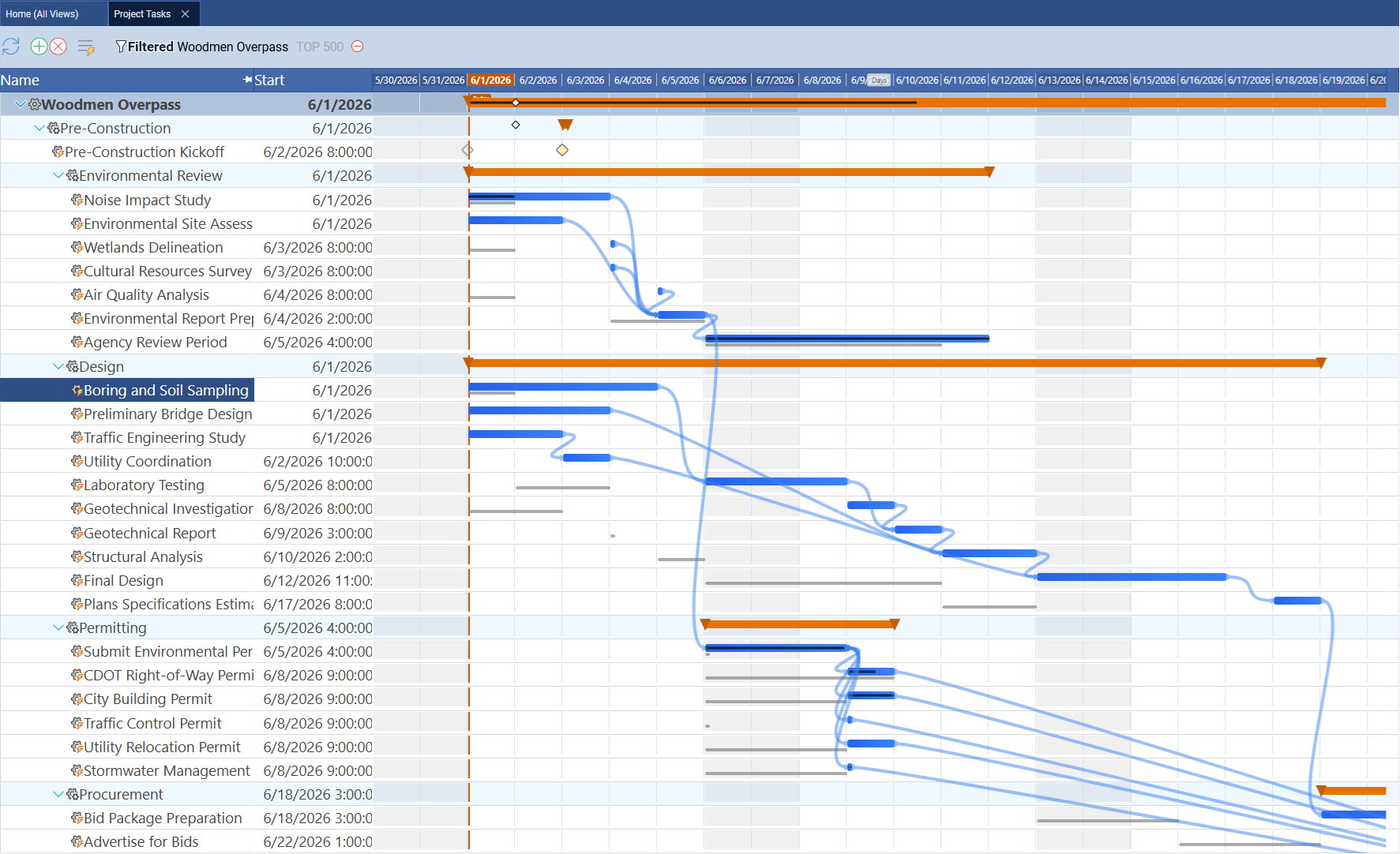
Go to Home → Projects, right-click the new program row, and choose Admin → Subprojects. Nine top-level phases and eighteen nested sub-groups should appear in the exact order and indentation from the pasted text. Then go to Home → Users and confirm the resource pool: 37 named resources split across three top-level workgroups — Research Staff, Reagents and Consumables, and Lab Equipment — each with the correct Human, Material, or Machine type.
Audit note: count your Human resources before you celebrate. This paste force-creates ten Human resources — the Principal Investigator, Study Director, two Research Associates, a Molecular Biologist, a Bioinformatics Scientist, a QA/Regulatory Affairs Specialist, an IACUC Liaison, a Flow Cytometry Core Operator, and an Animal Facility Veterinarian — and each one consumes a paid license seat, unlike the Machine and Material resources. If you are running this blueprint on a trial account with a small seat allotment, check Tools → Account for your current seat count before pasting. Going over is expected for a blueprint exercise; just know it is coming rather than being surprised by it.
Protocol 4: Wire the Off-Target QC Gate Dependencies
The tagged text block sets duration, start date, and resource assignment for every task — but there is no dependency tag in the format. Predecessor and successor links are the one piece of a Maverick schedule this paste cannot build for you, so a handful of them need to be wired by hand afterward, the same way as the fully manual blueprints on this site.
You do not need to link all 164 tasks by hand — only the ones where sequence actually matters for the story this schedule tells. Right-click Off-target mismatch scoring and analysis, choose Links..., and add Off-target analysis QC gate review as an outbound Finish-to-Start successor. Then link the QC gate review as a Finish-to-Start predecessor to Karyotype analysis of edited clones — clonal expansion should not proceed past the safety gate. Finally, link Genomic stability sign-off Finish-to-Start into HBB mRNA expression assay by qRT-PCR, since functional validation should not start on a clone whose genome has not been confirmed stable.
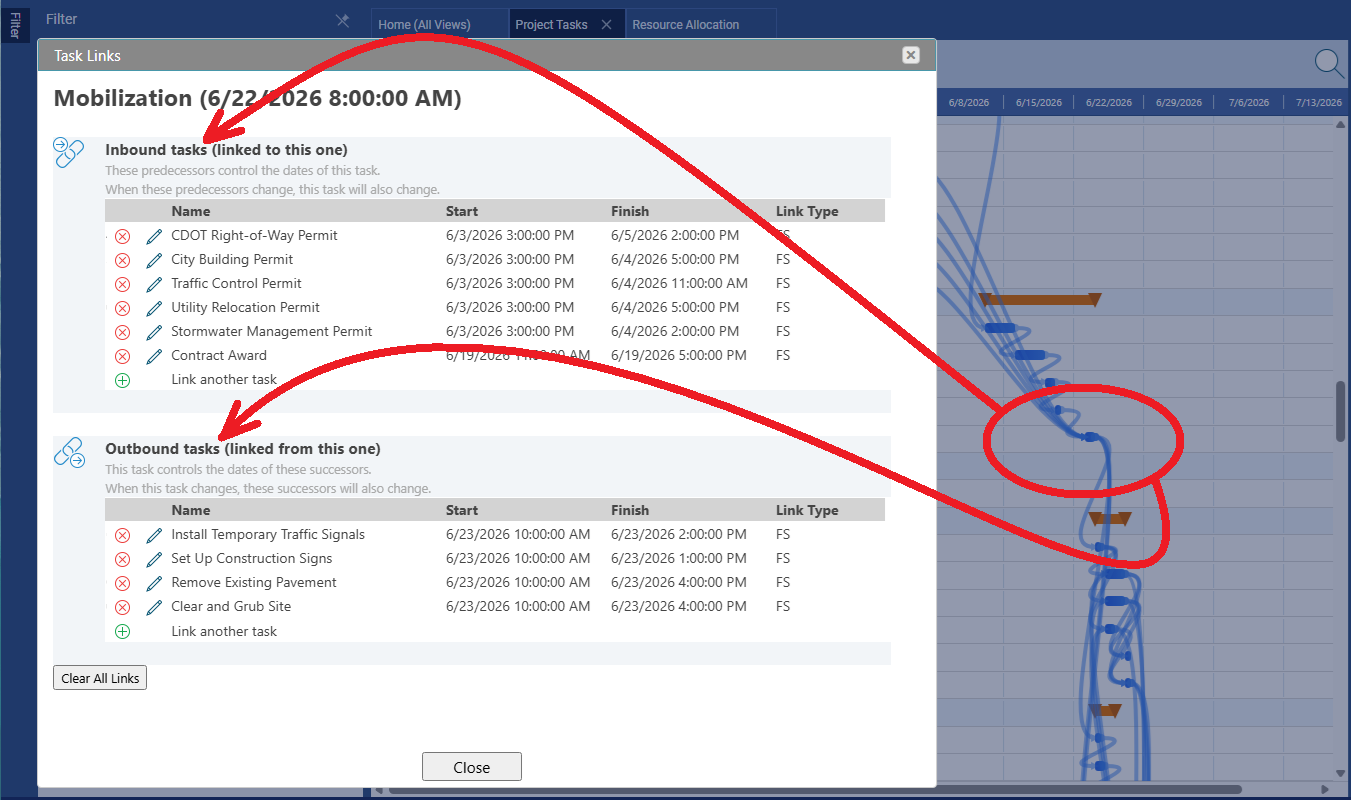
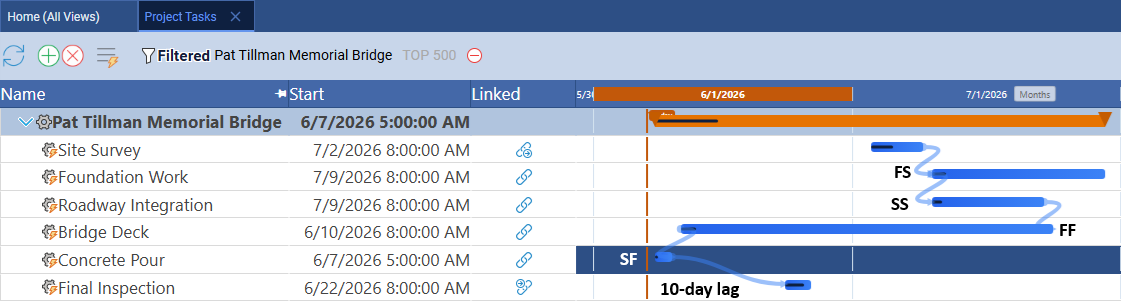
Definition: what a failed QC gate means for the schedule. Maverick does not automatically loop a task backward when a downstream check fails — that decision belongs to you. If the off-target mismatch score comes back above tolerance, the correct move is to unlock the Genotype Screening sub-group, add a fresh round of clone screening tasks, and re-run the off-target analysis on the next candidate clone. The QC gate link you just wired is what makes that failure visible on the Gantt in the first place — without it, a failed clone would silently slide into karyotyping with nothing stopping it.
Protocol 5: Set the Baseline
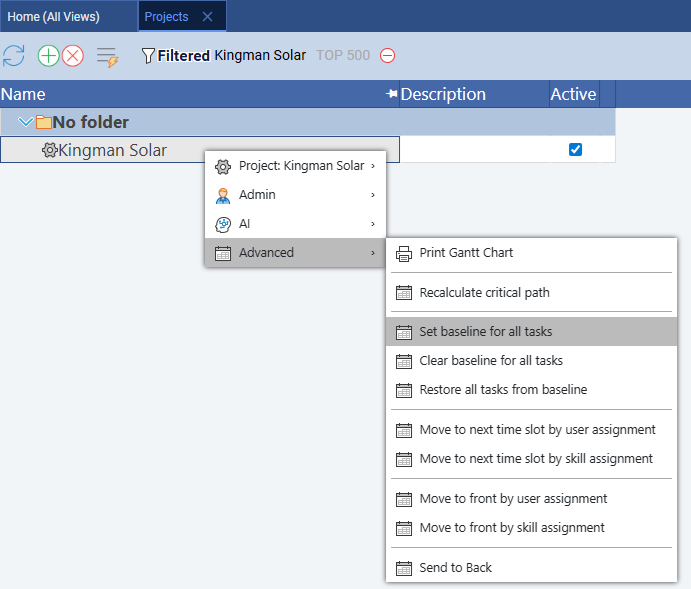
Right-click the program row and choose Advanced → Set baseline for all tasks. This locks every task's current start and finish date as the reference plan before any lab work begins.
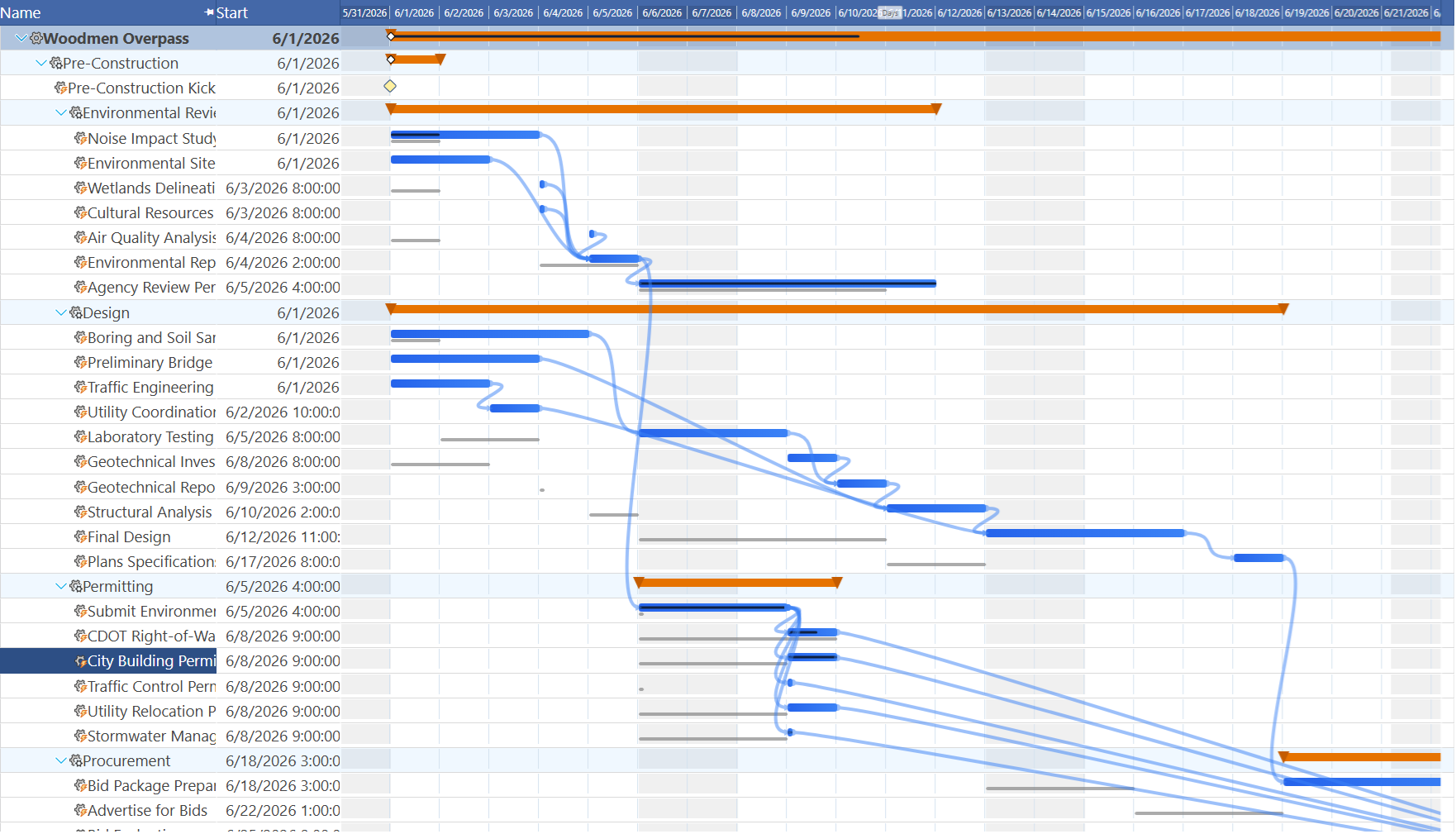
Look for the difference between a procurement ghost bar and a review ghost bar. The Cas9 nuclease order carries a 56-day ghost bar — a supplier lead time that does not move no matter how the lab performs. The IACUC committee review carries a 21-day ghost bar that is nominally fixed but, in practice, is the one most likely to slip if the committee asks a clarification question. When you track variance against this baseline later, a drifted procurement bar tells you to renegotiate a delivery date; a drifted review bar tells you to call the compliance office.
Protocol 6: Run the Critical Path
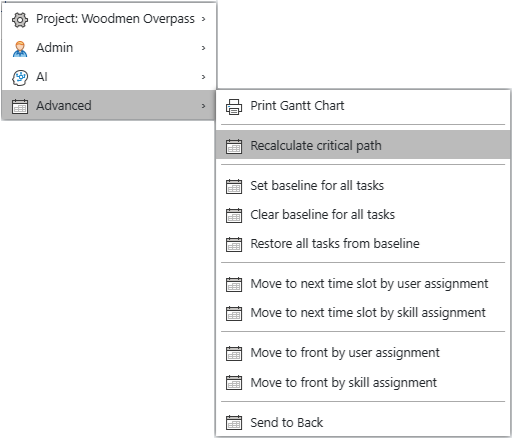
Right-click the program row and choose Advanced → Recalculate critical path. Critical tasks appear in red.
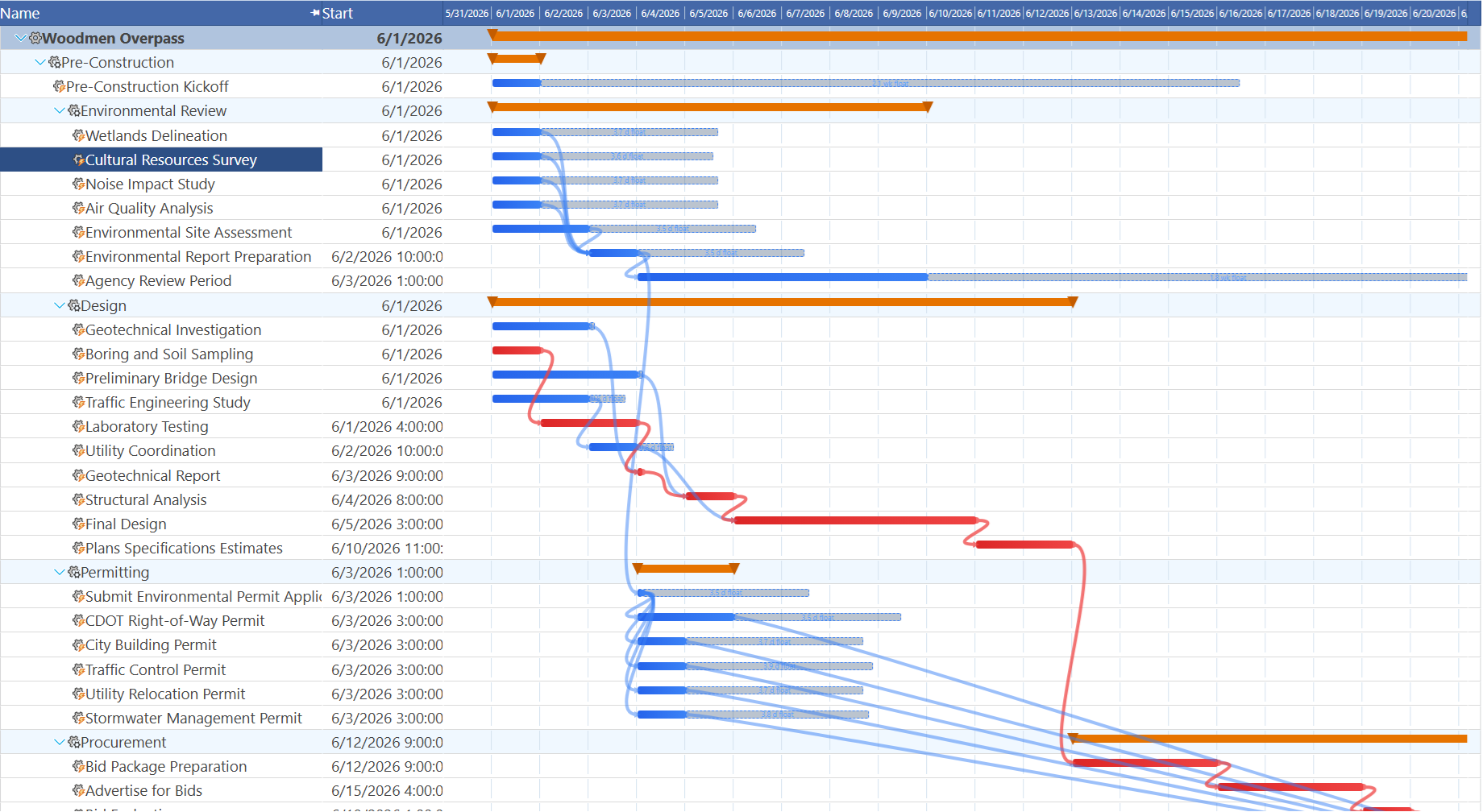
Industry insight: the critical path here runs through a sequencer and a mouse, not a crane. Once the QC gate links from Protocol 4 are in place, the zero-float chain runs through NGS turnaround for off-target analysis and the 84-day xenograft engraftment monitoring window — a duration set by mouse biology, not by adding staff or working overtime. No amount of crashing or fast-tracking shortens a fixed biological observation period. That is the single biggest scheduling lesson this blueprint teaches: on a construction site, the critical path usually responds to more resources; in a wet lab, it frequently does not.
Protocol 7: Check the Resource Allocation
Open the resource allocation bar chart to confirm no resource is double-booked across overlapping tasks.
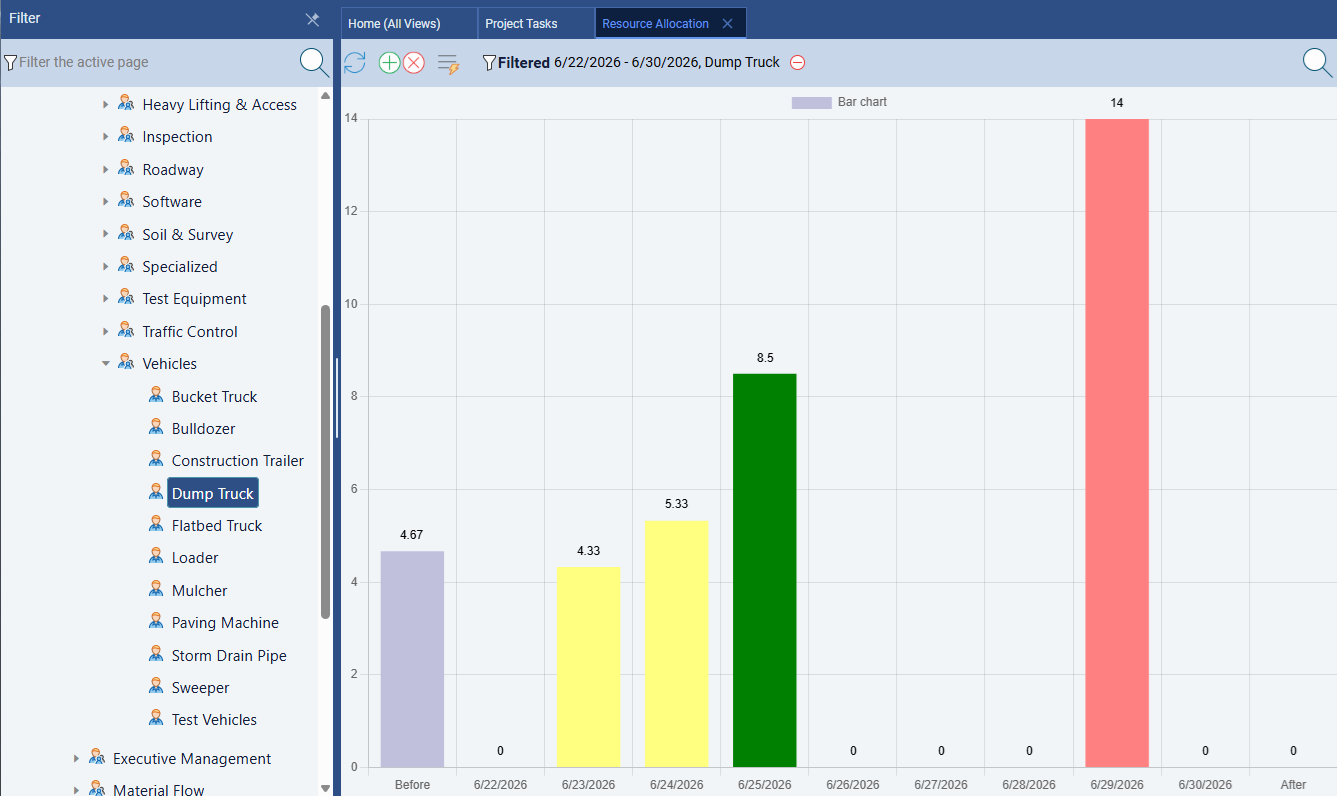
The Animal Facility Veterinarian is a single-point constraint spanning five separate tasks. Quarantine, engraftment, biweekly monitoring, terminal analysis, and necropsy all depend on the same named resource across a window of more than 100 days. If this individual is already committed to another study during that stretch, the allocation chart will show a red overallocation bar, and no amount of resequencing the lab-bench tasks will fix it — only a second qualified veterinarian resource or a shifted xenograft start date will. Check this resource's calendar before you set the baseline in Protocol 5, not after.
Protocol 8: Explore the Resource-Centric Gantt
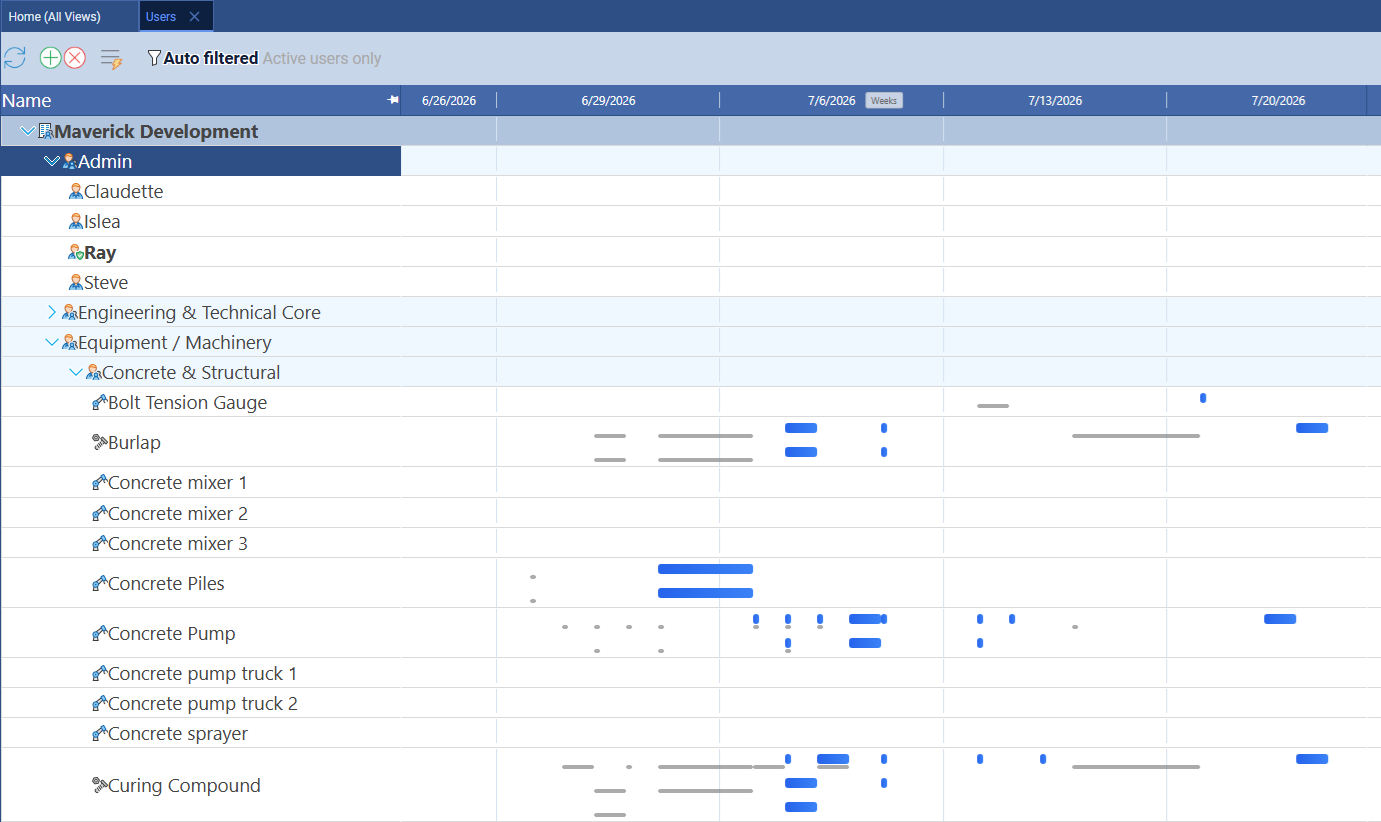
Switch to the resource-centric Gantt to see all three resource types laid out across the full eighteen-month program.
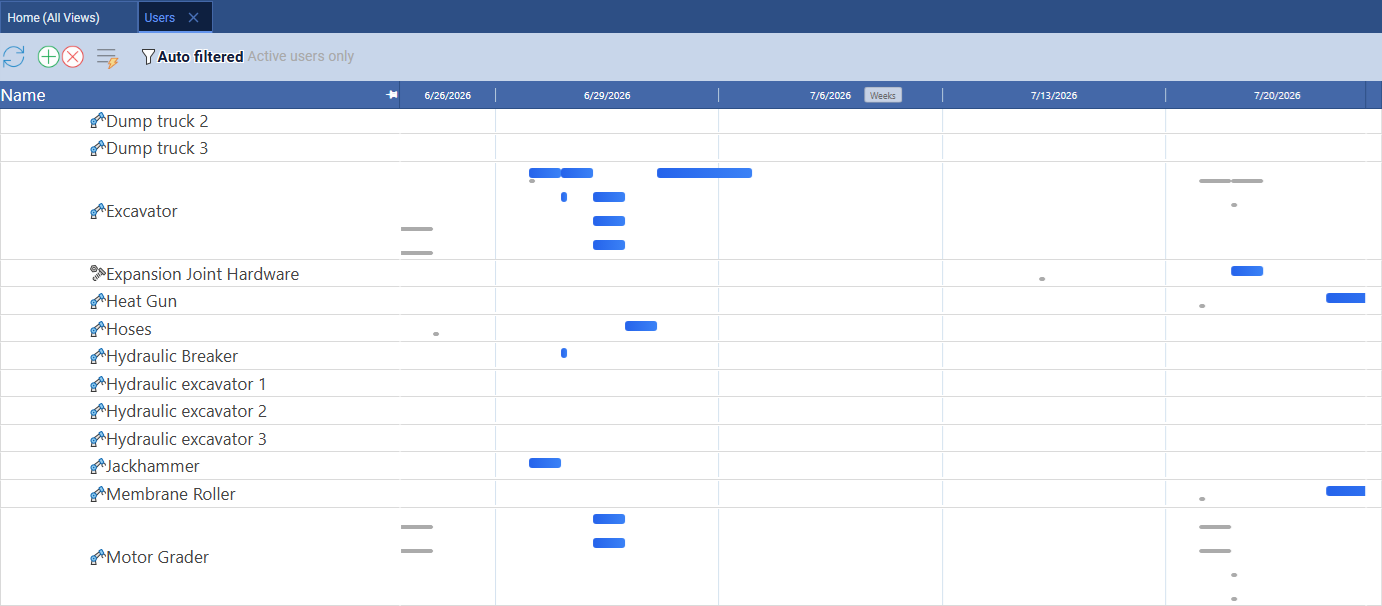
What to look for in the resource Gantt. Material rows — Cas9 nuclease, gRNA, donor DNA — should cluster almost entirely in the first six weeks, where procurement happens. Machine rows — the sequencers, the flow cytometer, the digital droplet PCR system — should show short, dense bursts spread across the whole program rather than continuous use, since shared core instruments serve many tasks briefly rather than one task for a long stretch. Human rows should spread the most evenly of all three, with the Animal Facility Veterinarian's row visibly concentrated in the back third of the timeline where the xenograft study lives.
Optional: Ask AI to Audit What You Pasted
This blueprint did not use AI to build the schedule — the tagged text block did that. But Maverick's AI chat still works on any project regardless of how it was created, and a second opinion on a 164-task program is worth the five minutes it takes. Right-click the program row and choose AI → Chat with AI.
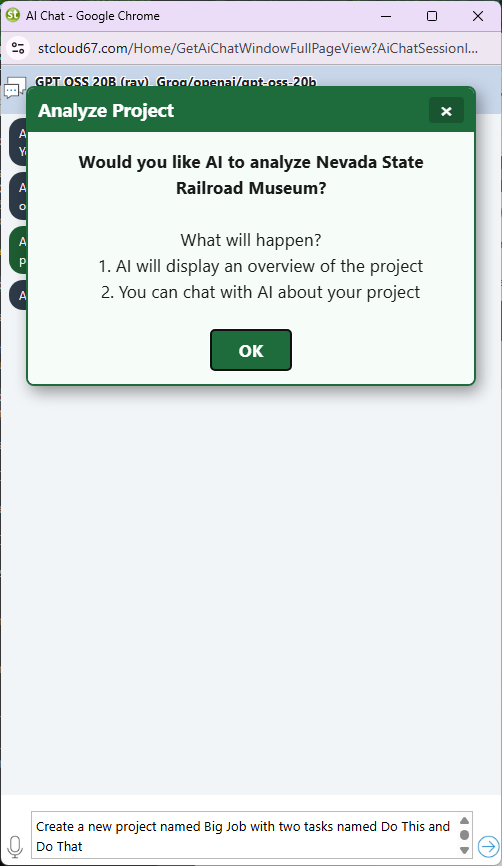
Quick prompts to try on the HBB Locus Correction Program:
- Which tasks have no predecessors and no successors? Which of those should be linked to the off-target QC gate chain?
- Is the Animal Facility Veterinarian assigned to any overlapping tasks outside the xenograft study window?
- If the IACUC committee review takes 35 days instead of 21, what is the cascade impact on the program finish date?
- Summarize the program at a glance: total duration, number of critical tasks, and the single biggest schedule risk.
Related Topics
For a full explanation of Gantt chart task bars, link lines, and the baseline ghost bars used in Protocols 4 and 5, see Gantt Charts in Project Management. For how Maverick calculates zero-float tasks and what a fixed biological observation window means for schedule risk, see Critical Path Method. For the full workflow of setting, clearing, and restoring baselines, see Project Baselines: Set, Clear, and Restore. For how to read the resource allocation bar chart and resolve the kind of single-resource overallocation described in Protocol 7, see Resource Allocation Bar Chart. To see a fully AI-built alternative to this technique, follow the Battery Energy Storage System blueprint; to see a fully manual, click-by-click approach instead, follow the 5MW Solar Plant Buildout blueprint. For how these same mechanics apply across gene therapy, biologics, and preclinical R&D more broadly, see Project Scheduling Software for Biotech & Life Sciences Teams.